*- New to team
Defensive Ends: #90 Julius Peppers, #71 Israel Idonije, #99 Shea McClellin*, #94 Chauncey Davis, #98 Corey Wootton, #93 Thaddeus Gibson, #76 Cheta Ozougwu*
The first three spots are obviously set. Julius Peppers is the best pass rusher Chicago's had since Richard Dent and will continue to play nearly every snap on defense so long as he's healthy. Izzy is still solid against the run even if his pass rush declined considerably. He'll probably get the starting nod over McClellin for most of the year, but he'll lose nearly all of his 3rd down reps and more than that as the season goes along. McClellin will get every opportunity to play and play often. Try to remember 2006 Mark Anderson. That's the plan for McClellin.
The real interesting story here is whether Corey Wootton can hang on to a roster spot. The Bears had high hopes for Wootton before he lost nearly all of last season to injury. If he can show the talent that made him a potential first rounder in college before his injuries set in, he'll get an opportunity. If not, I'd expect the Bears to keep the solid, unimpressive Chauncey Davis, who was drafted by Atlanta when Phil Emery was a scout there. Gibson's a long shot over Davis and Wootton, and Ozougwu's awesome name won't be enough to get him to the final 53.
Defensive Tackles: #69 Henry Melton, #92 Stephen Paea, #75 Matt Toeiana, #78 Nate Collins*, #70 John McCargo*, #79 Ronnie Cameron*, #96 Jordan Miller*, #68 DeMario Pressley
The thinnest position on the depth chart, which is scary considering the importance of DTs in Lovie's scheme. I like the starters, as Henry Melton was my pick for breakout player last year and I think he'll be even better and more consistent this year. Paea will take a huge leap forward in year two. He's an absolute monster. Toeiana is a solid runstuffer.
The rest of the lineup is a bunch of flotsam and castoffs. McCargo is a former first round pick who has never done anything. Nate Collins is already suspended for the opener. Cameron, Miller, and Pressley are just bodies. I'd expect someone to be picked up before the season, but if not I assume we'll see plenty of situations where Izzy moves back inside on pass-rushing downs while McClellin takes over at end.
Linebackers: #54 Brian Urlacher, #55 Lance Briggs, #53 Nick Roach, #91 Geno Hayes*, #52 Blake Costanzo*, #58 Dom DeCicco,#97 JT Thomas, #64 Ronnie Thornton*, #59 Patrick Trahan, #95 Adrien Cole*, #57 Jabara Williams
Urlacher and Briggs will take every snap so long as they're healthy, obviously. Roach is chronically underrated and rarely makes a mistake, but Hayes can play all three spots and has more potential (and also makes a ton of mistakes), so that battle should be interesting.
The backup linebackers are all extremely important on special teams, so I'd have to believe the Bears didn't sign Costanzo only to make him compete for a roster spot. He's in. They seem to like Dom DeCicco quite a bit, so he's my best bet as well. The Bears sometimes keep five linebackers and other times keep six, so Thomas and the others will have to show something in order to stay on. I'm guessing Patrick Trahan is most likely to stick out of that group.
Cornerbacks: #33 Charles Tillman, #26 Tim Jennings, #30 DJ Moore, #24 Kelvin Hayden*, #27 Jonathan Wilhite*, #36 Cornelius Brown*, #31 Isaiah Frey*, #39 Greg McCoy,
Tillman and DJ are locked in as the starters at LCB and Nickel, respectively, and they should be. Tillman's one of the best Cover 2 corners...ever. Moore has so far been the best nickelback of the Lovie Era.
The battle between Jennings and Hayden should be extremely interesting. Jennings is younger and healthier and was solid in coverage last year. He didn't come up with turnovers, however, and that's key in this system. Hayden, when healthy, is a playmaker, and Lovie's coveted him for quite some time. Hayden's been injured often the last couple of years, however, so we'll see if he can crack the lineup. His roster spot is safe, regardless, and he adds quality depth.
Only one of the Wilhite, Brown, Frey, and McCoy group will make it, I believe. The Bears rarely carry six corners, and I think they'll be more inclined to keep six receivers again this year. Wilhite has a slight edge since he's a veteran that they targeted in the offseason, but Frey is the kind of big, physical corner Lovie wants. McCoy's greatest asset is his ability as a returner, and that's a tough way to crack this roster. He seems like a strong candidate for the practice squad or the IR/Redshirt. Cornelius is named Cornelius, so that's something.
Safeties: #47 Chris Conte, #27 Major Wright, #20 Craig Steltz, #35 Brandon Hardin*, #43 Trevor Coston*, #46 Jeremy Jones*, #37 Anthony Walters.
This one's pretty easy. Conte and Wright will start until Hardin takes Wright's job somewhere around week five. Steltz is an excellent special teamer and can play both spots (and played both of them well last year, which I'm still not convinced wasn't an aberration), so he's the primary backup. Walters played well and special teams last year and should get the nod over Jones and Coston for the fifth safety spot.
My prediction for the depth chart, barring injury and the likely free agent signing at defensive tackle:
RDE: Peppers/Wootton
LDE: Idonije/McClellin
3 Technique: Melton/Collins
Nose Tackle: Paea/Toeina/McCargo
WLB: Briggs/Trahan
MLB: Urlacher/DeCicco
SLB: Roach/Hayes
CB: Tillman/Moore/Frey
CB: Jennings/Hayden
FS: Conte/Steltz
SS: Wright/Hardin/Walters
That makes 25. Throw in the 25 I predicted on offense yesterday and add the locks on special teams in Robbie Gould, Adam Podlesh, and Patrick Mannelly and you have your 53 man roster. Seems like a damn fine team.
Go Bears.
Tuesday, July 24, 2012

Monday, July 23, 2012
Your Start Kyle Orton Bears Training Camp Preview: The Offense
Bears camp begins this week, so it's time for my annual look at the camp roster to try and shake out what the Bears will look like come opening day and what we might expect from those 53 guys. Today we start with the offense.
A brief recap: when we last left our heroes they were grinding out a meaningless season finale win over Minnesota that only resulted in Brian Urlacher getting injured on a Hail Mary...wait, Hail Mary......CHIEFS GAME...fuck...Chiefs...AFC West...TEBOW...MARION BARBER. CALEB HANIE. GAHHHHH. Why is there all this blood everywhere? Who put this dead horse in my bed? OH MY GOD, THAT'S NO HORSE, IT'S JOHN ELWAY...*wakes up in cold sweat* Jesus. Okay, where was I?
Oh yes, the Bears ended last season at 8-8 following an excellent 7-3 start and a horrifing 1-5 finish. Since then they've replaced the GM, overturned the talent at the offensive skill positions, took care of several headaches by re-signing Lance Briggs and Matt Forte, and now enter training camp free of controversy and full of optimism. This should be good. Let's see who gets to have fun in Bourbonnais over the next month:
*- New to team.
QUARTERBACKS: #6 Jay Cutler, #2 Jason Campbell*, #12 Josh McCown, #4 Matt Blanchard*
No surprises expected here, of course. Cutler will start so long as he stays healthy, which will hopefully be all 16 games, and the franchise goes as he goes. Even ESPN has come around to the idea that they were wrong about him, since the addition of actual talent on offense means Jay will finally put up numbers they can't ignore. This will be his best year yet.
Jason Campbell, not long ago, was the type of guy Bears fans would have worshipped: slightly above average. He's more than capable of keeping the ship upright if Cutler goes down again. Ideally you never have to use him, but even if the exact same scenario as last year should happen again (Cutler out for 5-6 weeks, team simply needs to go .500 to keep playoff hopes alive) the Bears are in an infinitely better situation than they were a year ago thanks to Jason.
McCown makes a lot of sense as the third stringer. Considering the team will likely only get to him if the offensive line is so bad that it gets both Cutler and Campbell knocked out, it's not a bad idea to have a guy who can run for his life back there.
Matt Blanchard went to the University of Wisconsin-Whitewater. I hope he enjoys his two week break from working as a kayaking instructor, which I assume is the only degree available at the University of Wisconsin-Whitewater.
Obviously the depth chart here is set and Blanchard's just a camp arm. Overall this is the best depth chart the Bears have had at QB since Johnny Lujack and Sid Luckman were both on the roster. Hopefully they don't need it, but it's nice to know it's there.
HALFBACKS: #22 Matt Forte, #29 Michael Bush*, #32 Kahlil Bell, #25 Armando Allen, #38 Lorenzo Booker*, #45 Harvey Unga
Forte and Bush are locks and will get about 90% of the touches. Forte is the best runningback the Bears have had in my lifetime (sorry, Neal Anderson and Thomas Jones), and I'm glad he's been extended. Bush is attempt #3 at finding a highly paid complement to Forte. Marion Barber, statistically, wasn't bad, but was oft-injured and fell out of favor after the Denver game. Bush should easily exceed Barber's production and should outproduce Chester Taylor's 2010 season somewhere around the third preseason game.
Kahlil Bell was tendered as a restricted free agent, and should make the roster as the #3 back, but he may have some competition as the Bears signed veteran Lorenzo Booker last week. Booker has some more experience on special teams than Bell, and the Bears may want to go cheaper at the #3 HB spot since they've invested so much in Forte and Bush. Bell himself may want an opportunity to earn more carries on a team with a less crowded depth chart.
I don't expect Armando Allen to make the roster. that's really all I have to say about him. I forgot all about Harvey Unga, who the Bears took in the supplemental draft in 2010 and who has now been injured or dismissed for personal reasons for two seasons. He'll be cut as well.
FULLBACKS: #44 Tyler Clutts
Clutts is overrated by meatballs who were just happy to have a fullback again, but it looks like he's here to stay. Oh well. At least we'll get more horrible puns every time another checkdown pass bounces off of his stone hands.
WIDE RECEIVERS: #15 Brandon Marshall*, #17 Alshon Jeffery*, #80 Earl Bennett, #23 Devin Hester, #14 Eric Weems*, #11 Devin Thomas*, #13 Johnny Knox, #18 Dane Sanzenbacher, #81 Terrien Crump*, #82 Britten Golden*, #19 Joseph Anderson*, #83 Chris Summers*
This is the most vastly upgraded unit on the Bears roster, and maybe the most improved receiving corps in the NFL.
The top four are clear: Marshall is the big, game-changing receiver the Bears haven't had, well, ever. Jeffery has the potential to be Brandon Marshall. The BBE, who will hopefully stay healthy this year, is an outstanding slot/possession guy who can also play outside the hashes opposite of Marshall when the Bears stick Hester in the slot to work him deep (something they'll do more this year than they ever have). Hester is now a role-player, something he was always meant to be.
The real question comes after those four. How many receivers will the Bears keep? Last year they kept six, the first time in the Lovie Era where they've kept more than five. They'll probably keep six again this year as Eric Weems is a lock for the roster as well, but probably won't see any reps at wide receiver since he's simply a poor man's Devin Hester.
So who is the sixth man? Knox is easily taken care of, as they're not going to throw him out there before he's 100% healthy and they may not want him anymore as it is. He'll likely hit the injured reserve, or maybe the PUP list, and the Bears will make their decision on whether to cut or keep him after he's in playing shape again.
The camp bodies don't stand a chance, so ignore Crump, Golden, Anderson, and Summers, even if Crump has an awesome name.
It all boils down to a battle between Devin Thomas and Sanzenfucker for the last roster spot. Thomas is a 6'2, 221 former second round pick who may have some untapped potential on offense and has played very well on special teams in the NFL. Sanzenfucker is a roughly 4'8", 97 lb undrafted schmuck who didn't make an impact on special teams last year and only made the roster as Martz's little toy. He got some playing time when Bennett was hurt and committed the cardinal sin of white wide receiverdom by dropping six passes. My point, basically, is Sanzenfucker is gone and I will dance and bathe in the meatball asshurt the day he is cut. Welcome to the Bears, Devin Thomas!
TIGHT ENDS:#87 Kellen Davis, #89 Matt Spaeth, #88 Evan Rodriguez*, #86 Kyle Adams, #84 Draylen Ross*, #85 Brandon Venson*
In Ron Turner's last two years the Bears had one of the deepest tight end corps in the NFL, with Greg Olsen and the vastly underrated Dez Clark combining for nearly 1000 yds each year and Kellen Davis as the third string TE. After two years of transition under Martz, the Bears tight ends will once more be featured as receivers between the twenties.
Kellen Davis will start, and I'm confident he'll perform adequately in a much bigger role this year. I'd think 400-500 yds receiving and anywhere from 5-8 touchdowns would make sense. He'll lose some reps on third down to Rodriguez, who will also play in two tight end sets. I'd expect Rodriguez to chip in somewhere around 400 or so yards this year as well before earning more reps in year two. Spaeth may get some reps at fullback and is solely a blocking specialist. He may fit into a role similar to that of Jim Kleinsasser in Minnesota during Tice's Vikings years.
I don't think the Bears will break camp with more than 3 tight ends this year, so expect Kyle Adams to continue bouncing back and forth between the practice squad, the waiver wire, and the roster as he did last year. Draylen Ross and Brandon Venson will most likely never be heard from again.
OFFENSIVE TACKLES: #72 Gabe Carimi, #73 J'Marcus Webb, #74 Chris Williams, #75 AJ Greene*, #76 Brandon Cory*, #79 Tyler Hendrickson*
Carimi is the key to damn near everything this year. If he stays healthy and plays as well as most believe him capable off, the entire line will stabilize. If the line is stable, there'll be very little that can stop the Bears offense this year thanks to their additions at wide receiver and runningback. If Carimi goes down again? Let's just not discuss it. For the record, I think he'll be a great player.
Left tackle is still J'Marcus Webb's job to lose. Unfortunately, I think he's more than capable of losing it to Chris Williams. Williams was really coming along at guard before he went down, so moving him back to tackle is somewhat irritating. It's hard to say Williams was a bust at LT, though, since he started just seven games there between 09-10 before he was injured and later moved to guard. Whoever wins will benefit from a coordinator that places less emphasis on the left tackle as an isolated blocker. I think the Bears will make something work with these two this year and will avoid the disasters of the past, but I think a true standout will be their top priority next offseason.
The Bears usually carry only three tackles, so I'd expect Greene, Cory, and Hendrickson all to get cut. One of them will make their way to the practice squad of course.
OFFENSIVE GUARDS/CENTERS: #63 Roberto Garza, #67 Chris Spencer, #60 Lance Louis, #70 Edwin Williams, #62 Chilo Rachal, #78 James Brown, #64 Ricky Henry, #68 Nick Pieschel.
Garza and Carimi are the only two players locked into starting jobs on the offensive line at the moment. I think Spencer and Louis are the likely starters at guard, which makes sense. Louis has always played well at guard but has suffered from injuries and a move to right tackle forced by the awfulness of Frank Omiyale. While Louis was wildly inconsistent on the outside, he's earned the right to start on the interior. Spencer played very well last year and also deserves to begin the season as a starter.
The main backup should be Rachal, who is a dominating run blocker (the best run-blocking guard in all of football in 2010 according to ProFootballFocus), but extremely inconsistent in pass protection. If Tice can tap the potential that made Rachal a 2nd round pick in 2008 I'd expect him to force his way into the lineup. Edwin Williams played extremely well last year after Chris Williams went down, so there's no reason to expect him not to make the roster. I'd also not be surprised if the Bears go younger soon and drop Garza in favor of shifting Spencer to center and making room for Rachal or Eddie at guard. Either way, the Bears will be as capable on the interior as they were last year when they paved the way for over 2,000 rushing yards.
Henry and Pieschel are just guys, but James Brown is highly intriguing prospect from Troy who was at one point a potential second-third rounder at tackle. His versatility makes him difficult to cut, as the Bears may not be able to sneak him onto the practice squad. He may make the roster as a backup at both guard and tackle, or the Bears may try their injured reserve redshirt.
If you were keeping track, my expected depth chart on offense is this:
QB: Cutler/Campbell/McCown
HB: Forte/Bush/Bell
FB: Clutts
WR: Marshall/Jeffery/Bennett/Hester/Weems/Thomas
TE: Davis/Spaeth/Rodriguez
LT:Webb/C.Williams
LG:Spencer/E. Williams
C: Garza/Spencer
RG:Louis/Rachal
RT: Carimi/Brown
That's a total of 25 players if they opt to keep Brown on the roster.
As a whole, this offense should, provided the key players stay healthy, be the most productive unit the Bears have fielded since 1995. I probably could have just typed "JAY CUTLER TO BRANDON MARSHALL, TOUCHDOWN BEARS" and your pants would have exploded. I know mine just did.
Go Bears.
A brief recap: when we last left our heroes they were grinding out a meaningless season finale win over Minnesota that only resulted in Brian Urlacher getting injured on a Hail Mary...wait, Hail Mary......CHIEFS GAME...fuck...Chiefs...AFC West...TEBOW...MARION BARBER. CALEB HANIE. GAHHHHH. Why is there all this blood everywhere? Who put this dead horse in my bed? OH MY GOD, THAT'S NO HORSE, IT'S JOHN ELWAY...*wakes up in cold sweat* Jesus. Okay, where was I?
Oh yes, the Bears ended last season at 8-8 following an excellent 7-3 start and a horrifing 1-5 finish. Since then they've replaced the GM, overturned the talent at the offensive skill positions, took care of several headaches by re-signing Lance Briggs and Matt Forte, and now enter training camp free of controversy and full of optimism. This should be good. Let's see who gets to have fun in Bourbonnais over the next month:
*- New to team.
QUARTERBACKS: #6 Jay Cutler, #2 Jason Campbell*, #12 Josh McCown, #4 Matt Blanchard*
No surprises expected here, of course. Cutler will start so long as he stays healthy, which will hopefully be all 16 games, and the franchise goes as he goes. Even ESPN has come around to the idea that they were wrong about him, since the addition of actual talent on offense means Jay will finally put up numbers they can't ignore. This will be his best year yet.
Jason Campbell, not long ago, was the type of guy Bears fans would have worshipped: slightly above average. He's more than capable of keeping the ship upright if Cutler goes down again. Ideally you never have to use him, but even if the exact same scenario as last year should happen again (Cutler out for 5-6 weeks, team simply needs to go .500 to keep playoff hopes alive) the Bears are in an infinitely better situation than they were a year ago thanks to Jason.
McCown makes a lot of sense as the third stringer. Considering the team will likely only get to him if the offensive line is so bad that it gets both Cutler and Campbell knocked out, it's not a bad idea to have a guy who can run for his life back there.
Matt Blanchard went to the University of Wisconsin-Whitewater. I hope he enjoys his two week break from working as a kayaking instructor, which I assume is the only degree available at the University of Wisconsin-Whitewater.
Obviously the depth chart here is set and Blanchard's just a camp arm. Overall this is the best depth chart the Bears have had at QB since Johnny Lujack and Sid Luckman were both on the roster. Hopefully they don't need it, but it's nice to know it's there.
HALFBACKS: #22 Matt Forte, #29 Michael Bush*, #32 Kahlil Bell, #25 Armando Allen, #38 Lorenzo Booker*, #45 Harvey Unga
Forte and Bush are locks and will get about 90% of the touches. Forte is the best runningback the Bears have had in my lifetime (sorry, Neal Anderson and Thomas Jones), and I'm glad he's been extended. Bush is attempt #3 at finding a highly paid complement to Forte. Marion Barber, statistically, wasn't bad, but was oft-injured and fell out of favor after the Denver game. Bush should easily exceed Barber's production and should outproduce Chester Taylor's 2010 season somewhere around the third preseason game.
Kahlil Bell was tendered as a restricted free agent, and should make the roster as the #3 back, but he may have some competition as the Bears signed veteran Lorenzo Booker last week. Booker has some more experience on special teams than Bell, and the Bears may want to go cheaper at the #3 HB spot since they've invested so much in Forte and Bush. Bell himself may want an opportunity to earn more carries on a team with a less crowded depth chart.
I don't expect Armando Allen to make the roster. that's really all I have to say about him. I forgot all about Harvey Unga, who the Bears took in the supplemental draft in 2010 and who has now been injured or dismissed for personal reasons for two seasons. He'll be cut as well.
FULLBACKS: #44 Tyler Clutts
Clutts is overrated by meatballs who were just happy to have a fullback again, but it looks like he's here to stay. Oh well. At least we'll get more horrible puns every time another checkdown pass bounces off of his stone hands.
WIDE RECEIVERS: #15 Brandon Marshall*, #17 Alshon Jeffery*, #80 Earl Bennett, #23 Devin Hester, #14 Eric Weems*, #11 Devin Thomas*, #13 Johnny Knox, #18 Dane Sanzenbacher, #81 Terrien Crump*, #82 Britten Golden*, #19 Joseph Anderson*, #83 Chris Summers*
This is the most vastly upgraded unit on the Bears roster, and maybe the most improved receiving corps in the NFL.
The top four are clear: Marshall is the big, game-changing receiver the Bears haven't had, well, ever. Jeffery has the potential to be Brandon Marshall. The BBE, who will hopefully stay healthy this year, is an outstanding slot/possession guy who can also play outside the hashes opposite of Marshall when the Bears stick Hester in the slot to work him deep (something they'll do more this year than they ever have). Hester is now a role-player, something he was always meant to be.
The real question comes after those four. How many receivers will the Bears keep? Last year they kept six, the first time in the Lovie Era where they've kept more than five. They'll probably keep six again this year as Eric Weems is a lock for the roster as well, but probably won't see any reps at wide receiver since he's simply a poor man's Devin Hester.
So who is the sixth man? Knox is easily taken care of, as they're not going to throw him out there before he's 100% healthy and they may not want him anymore as it is. He'll likely hit the injured reserve, or maybe the PUP list, and the Bears will make their decision on whether to cut or keep him after he's in playing shape again.
The camp bodies don't stand a chance, so ignore Crump, Golden, Anderson, and Summers, even if Crump has an awesome name.
It all boils down to a battle between Devin Thomas and Sanzenfucker for the last roster spot. Thomas is a 6'2, 221 former second round pick who may have some untapped potential on offense and has played very well on special teams in the NFL. Sanzenfucker is a roughly 4'8", 97 lb undrafted schmuck who didn't make an impact on special teams last year and only made the roster as Martz's little toy. He got some playing time when Bennett was hurt and committed the cardinal sin of white wide receiverdom by dropping six passes. My point, basically, is Sanzenfucker is gone and I will dance and bathe in the meatball asshurt the day he is cut. Welcome to the Bears, Devin Thomas!
TIGHT ENDS:#87 Kellen Davis, #89 Matt Spaeth, #88 Evan Rodriguez*, #86 Kyle Adams, #84 Draylen Ross*, #85 Brandon Venson*
In Ron Turner's last two years the Bears had one of the deepest tight end corps in the NFL, with Greg Olsen and the vastly underrated Dez Clark combining for nearly 1000 yds each year and Kellen Davis as the third string TE. After two years of transition under Martz, the Bears tight ends will once more be featured as receivers between the twenties.
Kellen Davis will start, and I'm confident he'll perform adequately in a much bigger role this year. I'd think 400-500 yds receiving and anywhere from 5-8 touchdowns would make sense. He'll lose some reps on third down to Rodriguez, who will also play in two tight end sets. I'd expect Rodriguez to chip in somewhere around 400 or so yards this year as well before earning more reps in year two. Spaeth may get some reps at fullback and is solely a blocking specialist. He may fit into a role similar to that of Jim Kleinsasser in Minnesota during Tice's Vikings years.
I don't think the Bears will break camp with more than 3 tight ends this year, so expect Kyle Adams to continue bouncing back and forth between the practice squad, the waiver wire, and the roster as he did last year. Draylen Ross and Brandon Venson will most likely never be heard from again.
OFFENSIVE TACKLES: #72 Gabe Carimi, #73 J'Marcus Webb, #74 Chris Williams, #75 AJ Greene*, #76 Brandon Cory*, #79 Tyler Hendrickson*
Carimi is the key to damn near everything this year. If he stays healthy and plays as well as most believe him capable off, the entire line will stabilize. If the line is stable, there'll be very little that can stop the Bears offense this year thanks to their additions at wide receiver and runningback. If Carimi goes down again? Let's just not discuss it. For the record, I think he'll be a great player.
Left tackle is still J'Marcus Webb's job to lose. Unfortunately, I think he's more than capable of losing it to Chris Williams. Williams was really coming along at guard before he went down, so moving him back to tackle is somewhat irritating. It's hard to say Williams was a bust at LT, though, since he started just seven games there between 09-10 before he was injured and later moved to guard. Whoever wins will benefit from a coordinator that places less emphasis on the left tackle as an isolated blocker. I think the Bears will make something work with these two this year and will avoid the disasters of the past, but I think a true standout will be their top priority next offseason.
The Bears usually carry only three tackles, so I'd expect Greene, Cory, and Hendrickson all to get cut. One of them will make their way to the practice squad of course.
OFFENSIVE GUARDS/CENTERS: #63 Roberto Garza, #67 Chris Spencer, #60 Lance Louis, #70 Edwin Williams, #62 Chilo Rachal, #78 James Brown, #64 Ricky Henry, #68 Nick Pieschel.
Garza and Carimi are the only two players locked into starting jobs on the offensive line at the moment. I think Spencer and Louis are the likely starters at guard, which makes sense. Louis has always played well at guard but has suffered from injuries and a move to right tackle forced by the awfulness of Frank Omiyale. While Louis was wildly inconsistent on the outside, he's earned the right to start on the interior. Spencer played very well last year and also deserves to begin the season as a starter.
The main backup should be Rachal, who is a dominating run blocker (the best run-blocking guard in all of football in 2010 according to ProFootballFocus), but extremely inconsistent in pass protection. If Tice can tap the potential that made Rachal a 2nd round pick in 2008 I'd expect him to force his way into the lineup. Edwin Williams played extremely well last year after Chris Williams went down, so there's no reason to expect him not to make the roster. I'd also not be surprised if the Bears go younger soon and drop Garza in favor of shifting Spencer to center and making room for Rachal or Eddie at guard. Either way, the Bears will be as capable on the interior as they were last year when they paved the way for over 2,000 rushing yards.
Henry and Pieschel are just guys, but James Brown is highly intriguing prospect from Troy who was at one point a potential second-third rounder at tackle. His versatility makes him difficult to cut, as the Bears may not be able to sneak him onto the practice squad. He may make the roster as a backup at both guard and tackle, or the Bears may try their injured reserve redshirt.
If you were keeping track, my expected depth chart on offense is this:
QB: Cutler/Campbell/McCown
HB: Forte/Bush/Bell
FB: Clutts
WR: Marshall/Jeffery/Bennett/Hester/Weems/Thomas
TE: Davis/Spaeth/Rodriguez
LT:Webb/C.Williams
LG:Spencer/E. Williams
C: Garza/Spencer
RG:Louis/Rachal
RT: Carimi/Brown
That's a total of 25 players if they opt to keep Brown on the roster.
As a whole, this offense should, provided the key players stay healthy, be the most productive unit the Bears have fielded since 1995. I probably could have just typed "JAY CUTLER TO BRANDON MARSHALL, TOUCHDOWN BEARS" and your pants would have exploded. I know mine just did.
Go Bears.
Thursday, July 19, 2012
Preseason Colleg Previewkakke: SEC West Division and Championship


Onto the SEC West, home to the winners of four of the last five National Championships. Remember when Mike Shula coached Alabama? Ah, the good days. Alas, all good things are destined to end, and Nick Saban ended up turning not one, but TWO SEC West universities into juggernauts. First a national title with LSU, then a short dalliance with the Miami Dolphins, then a quick and humorously lie-filled exit (Alabama? What’s that?) which saw him retreat back to the same freaking division as the college team he had left merely two years prior. Now? A damned dynasty wherein the man whose name is eerily similar to a certain fiery demon wins a title every couple years.
Add to this the LSU Tigers, who hired Les Miles after Saban left, which has led to some of the most fantastic endings/games in college football history (And another national title for LSU). Add to that Arkansas, who just fired its bike-riding, daughter’s-age-girl-banging, Atlanta Falcons-leaving head coach… and replaced him with John L. Smith. John L. Smith inspired THIS. That is all.
Outside of those three incredible stories we also have three other coaches in transition. Gene Chizik at Auburn needs to prove he can win without Cam Newton. Dan Mullen needs to take the next step with Mississippi State. And Texas A&M needs to prove they can compete in the SEC when they struggled so mightily to do just that in the Big 12-2.
So what happens in the most storyline-laden division in the NCAA? Glad you asked! Because I happen to have a fresh batch of 100% truthful predictions right after the jump:
Predicting the Playbook
The Bears are rarely a team with an over-arching offensive philosophy. While Green Bay had Mike Holmgren, a West Coast purist if ever there was one, and followed him up with two more West Coast adherents in Mike Sherman and Mike McCarthy (although McCarthy's obviously branched out and adapted many spread concepts thanks to Aaron Rodgers' incredible ability and his plethora of talented receivers), the Bears offensive coordinators throughout the years have mostly paid mere lip service to some over-arching scheme and have been pragmatic at best and clueless at worst.
Ron Turner claimed to be in the Don Coryell camp, but frequent injuries and talent deficiencies at quarterback often limited him to a more controlled short-passing scheme. Even when it worked, Turner's offense was hardly the deep-throw at all costs attack of Coryell disciples like Mike Martz. Ask any Bears fan or Bears opponent what Ron Turner wanted to do and the answer is quite simple: run the ball and throw off of play-action. It really was that simple.
Before Ron, Terry Shea spent one year trying to install Kansas City's version of the Martz offense, a more balanced and tight-end friendly alternative to Mike's original attack. It's really hard to describe Shea's offense as anything like Kansas City's at the time, since the offensive line was, recent history included, the worst in Bears history (66 sacks allowed) the receivers were, and stop me if you've heard this before, terrible, with David Terrell leading the pack, and the quarterbacks (Jonathan Quinn, Craig Krenzel, Chad Hutchinson) that came in after Rex Grossman went down in week 3 were incapable of completing even a rudimentary quick slant.
I'll not spend much time describing John Shoop's offense, since his philosophy simply revolved around avoiding turnovers and praying the defense would win the game, which leads us to Gary Crowton, the last Bears offensive coordinator before Mike Martz to have a reputation as a unique offensive mind. Crowton of course brought the spread to the NFL (well before the Patriots) and somehow got over 4,000 yds passing out of Shane Matthews, Cade McNown, and Jim Miller before the league caught on in 2000 and ran Crowton off to a disappointing head coaching career at BYU.
Considering this history, it's no surprise that the Mike Martz experiment was quite a radical departure from normal Bears procedure. Martz is nothing if not a man with his a strong commitment to his offensive philosophy, and it's one that undoubtedly produces when he has the talent to do so. In Chicago he did not, and we all know how that ended.
This long-winded digression into the history of recent Bears offensive schemes leads me up to my question today, which is: what the hell are the 2012 Bears going to run on Sundays now that they, once again, appear to be without one clear philosophy?
The only answers the media provides are somewhat contradictory. Mike Wright of ESPN claimed the Bears, thanks to Jeremy Bates, were going to use the 2008 Broncos playbook verbatim, which of course would mean that the Bears were running Mike Shanahan's version of the West Coast offense, which he developed by altering the original West Coast scheme to fit the running talents of Steve Young and later John Elway (which is also why he drafted the mobile Jay Cutler).
The offensive coordinator, however, is Mike Tice, not Jeremy Bates, and Tice has his own history on offense from when he and Scott Linehan (now the OC for the Lions) had a very productive operation going in Minnesota in the first half of the decade. So one would have to assume the Bears offense would resemble the Vikings playbook from that time period, no?
Well, that doesn't seem to be the case either. Many Bears players have noted that the playbook, with the notable exception of the recently eliminated seven step drops, still contains anywhere from 50-75% of last year's playbook. So I'm forced to wonder how all three of these influences (the Ghost of Martz, Tice/Linehan, and Bates/Shanahan) are going to gel into one coherent offensive scheme this year. I've decided to take a guess and explore a couple of run and pass concepts from all three offenses that I think the team will make extensive use of: Mike Martz's Mesh concept, Mike Shanahan's Near/Solo Left QB Keep Pass Right (in English: play-action bootleg to the right), and the Inside Zone running play from the Tice/Linehan offense.
1) MESH
Mesh is an outstanding concept that Martz had great success with all the way back in his earliest days of coaching. It's a play that's also been popularized in college by the Air Raid offenses of my beloved Mike Leach and his disciples. The great thing about Mesh is that, while it's a Martz staple, it's a shallow cross concept and doesn't require one of the dreaded deep drops. Here is Mesh as drawn up in Martz's offense:
The image is a little small, but basically the key to Mesh is that the X receiver (Brandon Marshall) and the Y receiver (Earl Bennett) cross paths in the middle of the field on what's known as a rub (in practice coaches will sometimes make these two receives touch hands so they understand just how close they need to get together on the play) in order to confuse the defense and get one of them open. The Z receiver (either Alshon Jeffery or Devin Hester) runs a deep curl to the middle of the field in order to draw one of the linebackers away from the X and Y as the CB goes deep to cover the RB on the wheel route. The QB then reads (as the illustration shows) right to left, from X to Z to Y.
This play is primarily designed to beat man coverage, but it can also be used against zone since the deep curl by the Z receiver will draw the MLB and the RB threatens both the flat and the sideline with the wheel route, keeping both the corner and safety in place on Cover 2. Martz's QBs have racked up hundreds of yards over the years on this play. The addition of a big, strong receiver in Marshall means that Jay should have no trouble turning this relatively short, easy throw into a big play.
2)Near/Solo Left Fake 15/35 QB Keep Pass Right
These two plays are basically identical, with the difference being that one has a fullback in the backfield who released into the flat and another has two tight ends, with the second tight end releasing into the flat. This is a concept that Shanahan/Bates have used to great effect with Steve Young, John Elway, Jake Plummer, and Jay Cutler (One of these things is not like the other...) and I would expect, given the repeated cries over the last three years for the Bears to take advantage of Cutler's ability to throw on the run, we will see it plenty this year:
Ron Turner claimed to be in the Don Coryell camp, but frequent injuries and talent deficiencies at quarterback often limited him to a more controlled short-passing scheme. Even when it worked, Turner's offense was hardly the deep-throw at all costs attack of Coryell disciples like Mike Martz. Ask any Bears fan or Bears opponent what Ron Turner wanted to do and the answer is quite simple: run the ball and throw off of play-action. It really was that simple.
Before Ron, Terry Shea spent one year trying to install Kansas City's version of the Martz offense, a more balanced and tight-end friendly alternative to Mike's original attack. It's really hard to describe Shea's offense as anything like Kansas City's at the time, since the offensive line was, recent history included, the worst in Bears history (66 sacks allowed) the receivers were, and stop me if you've heard this before, terrible, with David Terrell leading the pack, and the quarterbacks (Jonathan Quinn, Craig Krenzel, Chad Hutchinson) that came in after Rex Grossman went down in week 3 were incapable of completing even a rudimentary quick slant.
I'll not spend much time describing John Shoop's offense, since his philosophy simply revolved around avoiding turnovers and praying the defense would win the game, which leads us to Gary Crowton, the last Bears offensive coordinator before Mike Martz to have a reputation as a unique offensive mind. Crowton of course brought the spread to the NFL (well before the Patriots) and somehow got over 4,000 yds passing out of Shane Matthews, Cade McNown, and Jim Miller before the league caught on in 2000 and ran Crowton off to a disappointing head coaching career at BYU.
Considering this history, it's no surprise that the Mike Martz experiment was quite a radical departure from normal Bears procedure. Martz is nothing if not a man with his a strong commitment to his offensive philosophy, and it's one that undoubtedly produces when he has the talent to do so. In Chicago he did not, and we all know how that ended.
This long-winded digression into the history of recent Bears offensive schemes leads me up to my question today, which is: what the hell are the 2012 Bears going to run on Sundays now that they, once again, appear to be without one clear philosophy?
The only answers the media provides are somewhat contradictory. Mike Wright of ESPN claimed the Bears, thanks to Jeremy Bates, were going to use the 2008 Broncos playbook verbatim, which of course would mean that the Bears were running Mike Shanahan's version of the West Coast offense, which he developed by altering the original West Coast scheme to fit the running talents of Steve Young and later John Elway (which is also why he drafted the mobile Jay Cutler).
The offensive coordinator, however, is Mike Tice, not Jeremy Bates, and Tice has his own history on offense from when he and Scott Linehan (now the OC for the Lions) had a very productive operation going in Minnesota in the first half of the decade. So one would have to assume the Bears offense would resemble the Vikings playbook from that time period, no?
Well, that doesn't seem to be the case either. Many Bears players have noted that the playbook, with the notable exception of the recently eliminated seven step drops, still contains anywhere from 50-75% of last year's playbook. So I'm forced to wonder how all three of these influences (the Ghost of Martz, Tice/Linehan, and Bates/Shanahan) are going to gel into one coherent offensive scheme this year. I've decided to take a guess and explore a couple of run and pass concepts from all three offenses that I think the team will make extensive use of: Mike Martz's Mesh concept, Mike Shanahan's Near/Solo Left QB Keep Pass Right (in English: play-action bootleg to the right), and the Inside Zone running play from the Tice/Linehan offense.
1) MESH
Mesh is an outstanding concept that Martz had great success with all the way back in his earliest days of coaching. It's a play that's also been popularized in college by the Air Raid offenses of my beloved Mike Leach and his disciples. The great thing about Mesh is that, while it's a Martz staple, it's a shallow cross concept and doesn't require one of the dreaded deep drops. Here is Mesh as drawn up in Martz's offense:
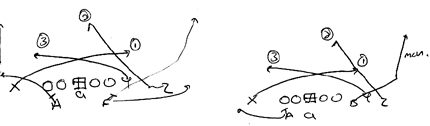 |
| Source: www.smartfootball.com |
This play is primarily designed to beat man coverage, but it can also be used against zone since the deep curl by the Z receiver will draw the MLB and the RB threatens both the flat and the sideline with the wheel route, keeping both the corner and safety in place on Cover 2. Martz's QBs have racked up hundreds of yards over the years on this play. The addition of a big, strong receiver in Marshall means that Jay should have no trouble turning this relatively short, easy throw into a big play.
2)Near/Solo Left Fake 15/35 QB Keep Pass Right
These two plays are basically identical, with the difference being that one has a fullback in the backfield who released into the flat and another has two tight ends, with the second tight end releasing into the flat. This is a concept that Shanahan/Bates have used to great effect with Steve Young, John Elway, Jake Plummer, and Jay Cutler (One of these things is not like the other...) and I would expect, given the repeated cries over the last three years for the Bears to take advantage of Cutler's ability to throw on the run, we will see it plenty this year:
 |
| Source: www.theburgundywarpath.com |
This play is pretty self explanatory, really. Cutler fakes it to Forte and rolls right, while Marshall (X) runs a deep comeback to the play side (taking advantage of the gap between corner and safety, as the corner should stay to cover the second tight end (T) or the FB in the flats and the LB should be preoccupied with the first TE (Y) running the shallow cross) and the Z (Hester or Jeffery) runs either a deep post against Cover 2 in order to draw the safety deep or a deep dig against Cover 1 in order to get the safety to "sink" on the route.
3)Inside Zone
This is a play that nearly every NFL team runs, and one that the Bears have already had a great deal of success with under Tice the last two years, but it's also a staple of the one-back offense that Tice/Linehan run and you'll see it plenty this year as well.
 |
| Source: www.smartfootball.com |
When you hear people talk about "zone runs" vs. man or power runs, the difference is what an "uncovered" lineman does. If a guard lines up and there's a defensive tackle right in front of him obviously his assignment is to block that guy. If there's not a defensive player directly in front of him, however, the offensive lineman's job is to shift towards the playside and double team the nearest defensive lineman. Once that defensive player is blocked, one of the two offensive lineman then shifts off to the nearest defender in the "zone" of the play. It's not really rocket science.
In the above version of inside zone, for example, the TE, RT, RG, and C all block the person covering them. The zone blockers are the LT and LG, who shift to block the WLB and the Nose Tackle, respectively. The runningback aims for the outside hip of the RG and shoot between the RG and the RT. If there's no opening there, he makes one cut and shoots back between the RG and the C. It's a running play that's both simple and effective, and Matt Forte and 30 other runningbacks will hear it called every Sunday. Tice has admitted in the past that it is his favorite running play, as he coaxed a 1300 yd season out of Michael Bennett and several great seasons from the two-headed monster of Fred Taylor and MJD largely off of this play during his time in Minnesota and Jacksonville, respectively.
So there you have it. I'm guessing the Bears offense will be very similar to the one they ran the last couple of years after the annual "Run the Damn Ball, Martz" intervention, with the biggest difference being a considerable increase in the amount of play-action passes and bootlegs, and fewer screens in response to pressure. These three plays, however, will almost certainly be locks for the gameplan every week. I apologize for the length of this post, but, shit, I really don't. If you're here, I assume you came to read.
Tuesday, July 17, 2012
Preseason College Previewkakke: SEC East Division

You may be asking yourself what order this round of previews is going in. If it were by national relevance, the SEC would obviously be the last conference previewed before the BCS Bowl prediction blowout. The SEC has won (approximately) the last 27 national titles and will, unless the SEC has 14 teams with at least 2 losses this season, send a minimum of one team to the National Championship. But this preview series is going in terms of relevance to our potential readership, and since anyone who cares about Chicago sports probably has a dog in either the Big 12-2 or B1G race, the SEC gets previewed before both of them.
What more can be said about the SEC? They’re dominant. They’ve had the undisputed champions in college football since 2007 and won it as well in 05 and 04 (05 Auburn was 13-0 despite not participating in the title game).
The most recent winners, however, lie in the West. That’s where LSU, Alabama, and Auburn (plus the ever-dangerous Arkansas) reside. The East is a division in transition. Florida was down last year, Tennessee has been down due to the Fulmer curse, Missouri is transitioning from the Big 12 minus 2, Vanderbilt has put together a couple top-25 recruiting classes and solid seasons, Mark Richt is regaining the respect of his fanbase, and Steve Spurrier is finally in contention for those titles his hiring promised.
Can any of these teams be relevant enough to contend for the SEC title (and thus the National Title)? Can any of them go unbeaten? How much credibility do I lose for what I’m about to say Vanderbilt will do? Let’s see! Here they are; 100% accurate predictions for the SEC East:
Monday, July 16, 2012
Paid the Man: Matt Forte Gets A Contract, Phil Emery Gets a Win, and Steve Rosenbloom is Still a Douche
In case you haven't heard, the Bears agreed to a four year, $32 million contract with Matt Forte today, with $18 million of that guaranteed. This is a good deal on so many levels, but I'm just going to note some of them:
1) The headache is gone. The effect of a distraction like this on a team is often as overrated as the idea of team chemistry. In this case, however, you can't help but be relieved that this story has gone away and the Bears, seemingly for the first time since the Superbowl in 2006, enter a season with mostly positive vibes and few major question marks. This is a good thing.
2) The Bears signed Matt Forte for below market value. Look at some of these contracts that runningbacks around the league signed in the last two years:
Frank Gore: 4 years, $26 million ($13.5 million guaranteed)
Marshawn Lynch: 4 years, $31 million ($17 million guaranteed)
LeSean McCoy: 6 years, $45.6 million ($20 million guaranteed)
DeAngelo Williams: 5 years, $43 million ($21 million guaranteed)
Arian Foster: 5 years, $43.5 million ($20.5 million guaranteed)q
Ray Rice (signed today after Forte): 5 years, $40 million ($24 million guaranteed)
I'm not even going to bother with the mega deals signed by Chris Johnson and Adrian Peterson, since that's a whole different monster, but there's no way anyone could say the Bears didn't just get a bargain on Matt Forte. The only guy in the above list who makes less money than Forte is Frank Gore, who is considerably older and was clearly on a gradual decline before he even inked his deal. The most similar contract is Marshawn Lynch, which is a joke considering Lynch isn't even remotely the kind of receiving threat that Forte is, that he averages just 4.0 ypc for his career (Forte is at 4.2, with a career high 4.9 last year), and that he just had his first 1000 yd season since 2008.
The Forte contract especially looks good when you look at the ludicrous deal given to DeAngelo Williams, who played fewer than half of the Panther's snaps on offense last year and yet gets more money than Forte, who accounted for almost half of all of the Bears total yards from scrimmage.
Ray Rice is probably the player most similar to Forte on that list, and he was able to leverage his way to an extra year and $6 million more in guaranteed money.
3) Phil Emery held his ground. Jerry Angelo lowballed Forte with a contract offer similar to the Frank Gore deal. Forte was insulted and as recently as a few weeks ago was talking about a deal almost identical to what Ray Rice just got. Emery held his ground and refused to go past 18 million guaranteed (which is basically what Forte would have gotten playing on the franchise tag the next two years, only now the Bears have the flexibility to shift that cash around to play with the cap). Emery's other offseason moves, such as the Brandon Marshall trade, the signing of Michael Bush, and the drafting of Alshon Jeffery reduced the team's dependency on Forte and thus his leverage. Emery knew this and negotiated accordingly. Competence of this level from the general manager of the Bears is still mindboggling.
4) This deal apparently irritates Steve Rosenbloom, one of Chicago's most irritating and idiotic columnists. Rosenbloom criticized the deal on The Score, saying that Emery caved and overpaid a runningback in what is "a passing league."
This is stupid on so many levels. One, Emery did not cave in any way. Forte got a deal that was both below market value and well below what he was asking for. How the hell did Emery cave?
Two, f*&k the "passing league" comment. The NFL isn't a passing league. It's a scoring league. The fact that teams like the Patriots, Packers, and Lions score a lot of points and get a lot of yards solely by throwing the ball doesn't somehow invalidate the benefit of a good running game. When the Bears had both Jay Cutler and Matt Forte last year, they were 6th in the NFL in scoring at 26 ppg. During the last five games, with Cutler, when Forte got 20 or more carries in nearly every game, the team was averaging 32 PPG. It would be foolish for the Bears to argue they don't need Matt Forte because it is a "passing league." Their offense is best when they have a running game and it could be argued that they'd be better off than Green Bay or Detroit, both of whom paid for their lack of a running game when it gave teams more time on the clock to take advantage of their shitty secondaries.
Simply put, the Bears locked up Forte for less than he deserved, based on the state of runningbacks around the league, and checked off another item on Phil Emery's very impressive first offseason. The Bears head into training camp now with nothing to worry about besides winning football games. They'll do plenty of that in 2012, and Matt Forte should be a big part of it.
Go Bears.
1) The headache is gone. The effect of a distraction like this on a team is often as overrated as the idea of team chemistry. In this case, however, you can't help but be relieved that this story has gone away and the Bears, seemingly for the first time since the Superbowl in 2006, enter a season with mostly positive vibes and few major question marks. This is a good thing.
2) The Bears signed Matt Forte for below market value. Look at some of these contracts that runningbacks around the league signed in the last two years:
Frank Gore: 4 years, $26 million ($13.5 million guaranteed)
Marshawn Lynch: 4 years, $31 million ($17 million guaranteed)
LeSean McCoy: 6 years, $45.6 million ($20 million guaranteed)
DeAngelo Williams: 5 years, $43 million ($21 million guaranteed)
Arian Foster: 5 years, $43.5 million ($20.5 million guaranteed)q
Ray Rice (signed today after Forte): 5 years, $40 million ($24 million guaranteed)
I'm not even going to bother with the mega deals signed by Chris Johnson and Adrian Peterson, since that's a whole different monster, but there's no way anyone could say the Bears didn't just get a bargain on Matt Forte. The only guy in the above list who makes less money than Forte is Frank Gore, who is considerably older and was clearly on a gradual decline before he even inked his deal. The most similar contract is Marshawn Lynch, which is a joke considering Lynch isn't even remotely the kind of receiving threat that Forte is, that he averages just 4.0 ypc for his career (Forte is at 4.2, with a career high 4.9 last year), and that he just had his first 1000 yd season since 2008.
The Forte contract especially looks good when you look at the ludicrous deal given to DeAngelo Williams, who played fewer than half of the Panther's snaps on offense last year and yet gets more money than Forte, who accounted for almost half of all of the Bears total yards from scrimmage.
Ray Rice is probably the player most similar to Forte on that list, and he was able to leverage his way to an extra year and $6 million more in guaranteed money.
3) Phil Emery held his ground. Jerry Angelo lowballed Forte with a contract offer similar to the Frank Gore deal. Forte was insulted and as recently as a few weeks ago was talking about a deal almost identical to what Ray Rice just got. Emery held his ground and refused to go past 18 million guaranteed (which is basically what Forte would have gotten playing on the franchise tag the next two years, only now the Bears have the flexibility to shift that cash around to play with the cap). Emery's other offseason moves, such as the Brandon Marshall trade, the signing of Michael Bush, and the drafting of Alshon Jeffery reduced the team's dependency on Forte and thus his leverage. Emery knew this and negotiated accordingly. Competence of this level from the general manager of the Bears is still mindboggling.
4) This deal apparently irritates Steve Rosenbloom, one of Chicago's most irritating and idiotic columnists. Rosenbloom criticized the deal on The Score, saying that Emery caved and overpaid a runningback in what is "a passing league."
This is stupid on so many levels. One, Emery did not cave in any way. Forte got a deal that was both below market value and well below what he was asking for. How the hell did Emery cave?
Two, f*&k the "passing league" comment. The NFL isn't a passing league. It's a scoring league. The fact that teams like the Patriots, Packers, and Lions score a lot of points and get a lot of yards solely by throwing the ball doesn't somehow invalidate the benefit of a good running game. When the Bears had both Jay Cutler and Matt Forte last year, they were 6th in the NFL in scoring at 26 ppg. During the last five games, with Cutler, when Forte got 20 or more carries in nearly every game, the team was averaging 32 PPG. It would be foolish for the Bears to argue they don't need Matt Forte because it is a "passing league." Their offense is best when they have a running game and it could be argued that they'd be better off than Green Bay or Detroit, both of whom paid for their lack of a running game when it gave teams more time on the clock to take advantage of their shitty secondaries.
Simply put, the Bears locked up Forte for less than he deserved, based on the state of runningbacks around the league, and checked off another item on Phil Emery's very impressive first offseason. The Bears head into training camp now with nothing to worry about besides winning football games. They'll do plenty of that in 2012, and Matt Forte should be a big part of it.
Go Bears.
Friday, July 13, 2012
Preseason College Previewkakke: Pac-12 North and Championship


Still a bit surprised something came up in Google Image Search when I typed in "Flying Cougar"
And now we move into the Northern half of the Pac 12. When conferences construct divisions these days they should do it with one thing in mind: “For the love of God, don’t make the Big 12 North.” The mistake the Big 12 made there was assuming that Nebraska could carry an entire division forever, and do it well enough to beat the best team out of Texas/Oklahoma/Texas A&M once every couple years. As everyone saw, this simply didn’t end up working out. Every big program has lulls, and when Nebraska went into a lull there was nobody in the Big 12 North who could realistically step up and contend with the South. This made for some real snoozers as far as Championship games go, culminating in the South winning every championship from 2004 to 2010 (when the championship could no longer be played).
Herein lies the problem with the Pac 12 as it is currently divided. The only power in the South is USC. Yes, that is one hell of a power, but history has shown that no program can sustain this level of success indefinitely. Alabama, Ohio State, Penn State, Nebraska, Miami (currently!), etc., have all gone through significant periods of time in which they produced mediocre teams. More proof? It happened to USC! From 1996-2001 USC won more than 6 games just one time.
When USC goes into a lull, who will step up? Arizona State? Utah? UCLA? Colorado? Sounds a lot like Missouri, Kansas State, Kansas, and… Colorado… to me. The Pac 12 North, however, has one team that could cement itself as a USC-type elite program in Eugene, OR (Thanks, Nike!), two teams with coaches building teams to contend for many years (the Washingtons; Mike Leach and Steve Sarkisian), one team that has shown the ability to contend at the highest level recently (Stanford) and two teams who have shown the ability to contend historically (Oregon State and Cal). What happens when USC goes down? Well… last year’s title game, basically. Good luck, USC! The only hope for a competitive Pac 12 title game rests with you!
So in this intensely competitive Pac 12 North, who will emerge victorious? How about the Ducks, with their menagerie of ever-changing uniforms? Can Stanford maintain their recent level of success? Can Mike Leach do for WSU what he did for Texas Tech (Hint: Yes)? Once again, with 100% accuracy, your 2012 Pac 12 North final standings:
Thursday, July 12, 2012
Preseason College Previewkakke: Pac-12 South Division

I wish Barkley would stop making me like him.
Moving on to a slightly more interesting conference, we start in the Pac-12 (Ah, the west coast, where the number after the conference name is accurate) South division. Unlike the ACC, most people actually know which teams are in the Pac-12 and care about what they do. Sometimes this is because they have a national title contender, sometimes it’s because of the crazy shit they do, but most of the time it’s because both of those things combine and form USC.
So here we have the Trojans, emerging anew from the cocoon of NCAA sanctions and bowl bans with the probable #1 overall pick in the 2013 NFL draft, a young coach who perhaps has enough experience to no longer be considered young, and national title aspirations. Last season USC couldn’t represent the Pac-12 South in the Pac-12 Championship or a bowl, and that ended up proving what pretty much everyone knew; this division is USC and a bunch of teams who are going to get beaten by USC. After a massive logjam the regular season ended with 6-6 UCLA winning this division. That earned them an ass-kicking at the hands of Oregon in the title game (Final score was 49-31, and it was worse than that, trust me) then a bowl bid… at 6-7… where they Fought Hunger in a bowl game sponsored by cheese… and lost to an equally undeserving Illinois team 20-14.
There is no question USC will return respectability to the division this fall, but are there other contenders that can push USC? This division has FOUR new coaches out of six, which should illustrate how terrible it was last season, and oh boy, are the four new coaches juicy. RichRod at Arizona attempting to resuscitate his career after the biggest disaster in Michigan history, Todd Graham at Arizona State after ditching Pittsburgh in the biggest asshole way possible, Jim Mora Jr. (HAHAHA) at UCLA which is… Jesus Christ UCLA… and a new head coach named who-fucking-cares at Colorado, where winning a single game should be considered a major accomplishment. Great pickup with Colorado, Pac-12. Real winners, they are.
So without further ado, venture beyond the jump for the 100% accurate predictions for the Pac-12 South:
Tuesday, July 10, 2012
No, YOUR Pass Defense Sucks: The Myth of the Bears Awful Secondary
For two straight years now I've heard that the secondary is a potential weakness keeping the Bears from Superbowl contention. Now, this irritates me for a couple of reasons. For one, when people tend to say _____ is keeping someone from Superbowl contention, they're usually basing that on some illusory concept of the ideal Superbowl champion rather than assessing the league as a whole and basing their opinion on that comparison. Those are the kinds of people who would never have imagined the 2007 or 2011 Giants winning the Superbowl, or that it was possible that the 32 ranked rushing offense (2009 Colts) or the 32nd ranked defense (2011 Patriots) would get a team all the way to the big game. So when I hear that the Bears secondary is a question mark for the team, I look at several other teams considered to be contenders, like the Packers, Patriots, and Lions, and wonder how the hell people get that idea.
Now, I'll admit the safety play on last year's team concerned me and I've addressed that before. Things were considerably better once Chris Conte replaced Chris Harris/Brandon Meriweather, and even Major Wright was adequate when healthy. With Conte, Steltz, Wright,and Hardin in the mix I'm optimistic that the disastrous pass defense of the first 5 games last year is long gone. I don't expect the starting duo for the Bears to consist of two hall of famers, but they'll be capable of limiting big gains and making the occasional play.
As for the cornerbacks, I've already spent time defending the two best cornerbacks in the NFC North, Charles Tillman and Tim Jennings, who both allowed less than 60% completions and allowed only one gain of at least 47 yards. They're not flashy and they aren't going to blanket someone like Revis, but they're not asked to do so and they'll provide plenty of turnovers (well, P'Nut will).
So where does this idea that the Bears have a weak secondary really come from? An outdated concept like basing defenses on yardage allowed. The Bears finished 28th in the NFL in passing yards allowed, with 4065 yards allowed (254 ypg). That looks bad. But let's take a closer look:
1) The Bears were really good at stopping the run. After an awful and extremely atypical slow start against the run last year (135 ypg in the first 5), the Bears pulled Anthony Adams out of the nose tackle position (the key run stopper in the Cover 2) and replaced him with a Polynesian rotation of Paea and Toeiana. That switch led to a stingy run defense that allowed just 78 yards per game over the final 11 contests (consider also that in two of the mere 3 games in which they allowed over 100 yards rushing in that span, they faced Michael Vick and Tim Tebow). That was just a yard behind the 77 ypg allowed by the 49ers, the NFL's top run defense, during that time period.
What has this got to do with the pass defense? Well, futility in the run game forced teams to chuck it a lot against the Bears defense, for a whopping 631 attempts, good for 2nd in the NFL in most passing attempt against. Teams are naturally going to get a good amount of yardage on 631 attempts.
2) What did they do with those attempts, though? Well, 4065/631 equals just 6.4 YPA. In case you need a reference, that's like telling someone they're going to go up against Shane Matthews every game. They'll take it. That 6.4 YPA attempt against is good for 3rd best in the NFL, right up there with the Ravens. Something tells me no one's saying their secondary is going to keep them out of the Superbowl. Everyone knows that's Joe Flacco.
3)Interceptions. The Bears got 20 of them. Tied for 6th most in the NFL. They allowed 22 touchdown passes, good for 13th fewest in the NFL.
4)Opponent Passer Rating. Passer rating is a flawed stat, but the Bears still held opponents to just a 79.8 rating, good for 8th best in the NFL.
5) The Bears had to face Aaron Rodgers (2x), Matthew Stafford (2x), Drew Brees, Matt Ryan, Cam Newton, Philip Rivers, and Michael Vick last year, the only team in the NFL to face that particular gamut. That's 9 games against 7 of the top 11 passing yardage leaders in the NFL last year. They went 5-4 in those 9 games.
The only thing the Bears didn't do particularly well in pass defense last year was get after the quarterback. Although Melton and Peppers both had fine pass-rushing seasons, the Bears know they need another DE who can get after Aaron Rodgers and they drafted Shea McClellin to do so. I think people will see this year that, as usual, yards don't mean a damn thing against Lovie's defense.
So if the Bears secondary doesn't suck, do those same excuses apply to New England, Detroit, or Green Bay? No. Those teams aren't Cover 2 teams, and their secondaries, frankly, just plain suck. Look at the stats for opposing passers vs. those teams compared to the Bears stat line:
Chicago: 383/631 (60.7%), 4065 yds, 22 TDs, 20 INTs, 254 YPG, 6.4 YPA, 79.8 Rating
Green Bay: 390/637 (61.2%), 4796 yds, 29 TDs, 31 INTs, 299.8 YPG, 7.5 YPA, 80.6 Rating.
Detroit: 376/604 (62.3%), 3831 yds, 26 TDs, 21 INTs, 239.4 YPG, 6.4 YPA, 82.1 Rating
New England: 386/619 (62.4%), 4703 yd, 26 TDs, 23 INTS, 293.4 YPG, 7.6 YPA, 86.1 Rating.
As you can see, all of those teams were worse than the Bears in nearly every category. The Lions lower yardage total can also be somewhat excused by the fact that their run defense (23rd in the NFL) was downright shitty, so they're much easier to attack in multiple ways. Now, I'm not saying those teams aren't Superbowl contenders (well, Detroit isn't), but simply that the Bears secondary is certainly looks much better when you compare it to several other contenders who give up plenty of yards, and touchdowns, in schemes that aren't designed to allow short yardage passes like the Bears defense is.
So, once more, I say: No, YOUR pass defense sucks.
Now, I'll admit the safety play on last year's team concerned me and I've addressed that before. Things were considerably better once Chris Conte replaced Chris Harris/Brandon Meriweather, and even Major Wright was adequate when healthy. With Conte, Steltz, Wright,and Hardin in the mix I'm optimistic that the disastrous pass defense of the first 5 games last year is long gone. I don't expect the starting duo for the Bears to consist of two hall of famers, but they'll be capable of limiting big gains and making the occasional play.
As for the cornerbacks, I've already spent time defending the two best cornerbacks in the NFC North, Charles Tillman and Tim Jennings, who both allowed less than 60% completions and allowed only one gain of at least 47 yards. They're not flashy and they aren't going to blanket someone like Revis, but they're not asked to do so and they'll provide plenty of turnovers (well, P'Nut will).
So where does this idea that the Bears have a weak secondary really come from? An outdated concept like basing defenses on yardage allowed. The Bears finished 28th in the NFL in passing yards allowed, with 4065 yards allowed (254 ypg). That looks bad. But let's take a closer look:
1) The Bears were really good at stopping the run. After an awful and extremely atypical slow start against the run last year (135 ypg in the first 5), the Bears pulled Anthony Adams out of the nose tackle position (the key run stopper in the Cover 2) and replaced him with a Polynesian rotation of Paea and Toeiana. That switch led to a stingy run defense that allowed just 78 yards per game over the final 11 contests (consider also that in two of the mere 3 games in which they allowed over 100 yards rushing in that span, they faced Michael Vick and Tim Tebow). That was just a yard behind the 77 ypg allowed by the 49ers, the NFL's top run defense, during that time period.
What has this got to do with the pass defense? Well, futility in the run game forced teams to chuck it a lot against the Bears defense, for a whopping 631 attempts, good for 2nd in the NFL in most passing attempt against. Teams are naturally going to get a good amount of yardage on 631 attempts.
2) What did they do with those attempts, though? Well, 4065/631 equals just 6.4 YPA. In case you need a reference, that's like telling someone they're going to go up against Shane Matthews every game. They'll take it. That 6.4 YPA attempt against is good for 3rd best in the NFL, right up there with the Ravens. Something tells me no one's saying their secondary is going to keep them out of the Superbowl. Everyone knows that's Joe Flacco.
3)Interceptions. The Bears got 20 of them. Tied for 6th most in the NFL. They allowed 22 touchdown passes, good for 13th fewest in the NFL.
4)Opponent Passer Rating. Passer rating is a flawed stat, but the Bears still held opponents to just a 79.8 rating, good for 8th best in the NFL.
5) The Bears had to face Aaron Rodgers (2x), Matthew Stafford (2x), Drew Brees, Matt Ryan, Cam Newton, Philip Rivers, and Michael Vick last year, the only team in the NFL to face that particular gamut. That's 9 games against 7 of the top 11 passing yardage leaders in the NFL last year. They went 5-4 in those 9 games.
The only thing the Bears didn't do particularly well in pass defense last year was get after the quarterback. Although Melton and Peppers both had fine pass-rushing seasons, the Bears know they need another DE who can get after Aaron Rodgers and they drafted Shea McClellin to do so. I think people will see this year that, as usual, yards don't mean a damn thing against Lovie's defense.
So if the Bears secondary doesn't suck, do those same excuses apply to New England, Detroit, or Green Bay? No. Those teams aren't Cover 2 teams, and their secondaries, frankly, just plain suck. Look at the stats for opposing passers vs. those teams compared to the Bears stat line:
Chicago: 383/631 (60.7%), 4065 yds, 22 TDs, 20 INTs, 254 YPG, 6.4 YPA, 79.8 Rating
Green Bay: 390/637 (61.2%), 4796 yds, 29 TDs, 31 INTs, 299.8 YPG, 7.5 YPA, 80.6 Rating.
Detroit: 376/604 (62.3%), 3831 yds, 26 TDs, 21 INTs, 239.4 YPG, 6.4 YPA, 82.1 Rating
New England: 386/619 (62.4%), 4703 yd, 26 TDs, 23 INTS, 293.4 YPG, 7.6 YPA, 86.1 Rating.
As you can see, all of those teams were worse than the Bears in nearly every category. The Lions lower yardage total can also be somewhat excused by the fact that their run defense (23rd in the NFL) was downright shitty, so they're much easier to attack in multiple ways. Now, I'm not saying those teams aren't Superbowl contenders (well, Detroit isn't), but simply that the Bears secondary is certainly looks much better when you compare it to several other contenders who give up plenty of yards, and touchdowns, in schemes that aren't designed to allow short yardage passes like the Bears defense is.
So, once more, I say: No, YOUR pass defense sucks.
Preseason College Previewkakke: ACC Atlantic Division


This is why you go first, ACC.
ACC, part deux! The Atlantic finds itself in a situation oddly similar to the one it found itself in last season. FSU is supposed to be a title contender, there are a couple teams that could jump into a contending role, and Clemson is… Clemson. As they always are!
Largely due to an injury to E.J. Manuel Florida State lost to Oklahoma and Clemson. Not due to that injury, FSU lost to Wake Forest and Virginia. So, basically, Florida State did exactly what they’ve done every season since they joined the ACC; garner high expectations then fail to meet them. In the mean time a new head coach and some superiorly skilled offensive players jettisoned Clemson to an ACC Championship. Can FSU return to power? Can Clemson build using their young talent and their recent acquisition of the #1 prospect in the nation? Will NC State rally behind their potential first-round QB? And what of the equally mysterious seasons from Wake Forest, BC, and Maryland last year? Without further ado, your 100% accurate final standings for the ACC Atlantic division after the jump:
Thursday, July 5, 2012
Preseason College Previewkakke: ACC Coastal Division
College football season (and thus the prognostication bukkake) begins on August 30th, so over the next 56 days I will be providing previews of each major NCAA conference (sorry Big East, you don’t count anymore) and the National Championship picture. Code Red will add Phil Ste-errr-his own short takes and you can bet we’ll be keeping track of this throughout the year.
ACC Coastal Divison Preview:
Might as well start with the least interesting division in the conference readers probably care the least about! This is also maybe the one area Code Red will have unintentional blindness for, being as his beloved Georgia Tech with their beloved Triple Option reside in this division.
So, let me guess. All you know about the ACC is that they play basketball well and that college football on the east coast is a bigger clusterfuck than the BCS. The only consistent thing in the conference from year to year is that Virginia Tech will lose two games early for absolutely no reason then destroy the rest of the conference just to make sure nobody really cares about the ACC nationally.
And that segues nicely into the Coastal division, which just so happens to cradle Virginia Tech ever so lovingly in its bosom. The aforementioned clusterfuck generally leads to some serious intrigue right down to the last week of the season, and last year was no exception. Virginia Tech’s early season loss was an ass-whooping provided by Clemson (23-3), who in turn lost to Georgia Tech for no reason, who in turn lost to Virginia Tech, upstart Virginia, AND Miami. Virginia Tech didn’t lose another regular season game and marched into the ACC title game to face Clemson with a chance to avenge their only loss of the season.
As we all saw in the National Championship, it isn’t easy to beat a team twice in one season. And this is Virginia Tech! They finish strong! So obviously they’ll recover and… huh. Clemson destroyed VaTech 38-10, you say? Damnit, ACC. So how does the Coastal shake out this year? I struggled through every game for every team this season and came up with a completely scientific calculation of their records, and Code Red will be happy to include Phil Steel-oops- his, point of view for the division as well. Without further ado, my completely, 100% accurate ACC Coastal division predictions:
Team Overall W-L Conference W-L
Virginia Tech 11-1 (7-1)
Georgia Tech 9-3 (6-2)
Virginia 8-4 (5-3)
North Carolina 6-6 (3-5)
Miami (FL) 5-7 (3-5)
Duke 2-10 (0-8)
Virginia Tech: Pardon me if you’ve seen this story before, but the Hokies are going to go 11-1 with their one loss coming at Clemson on October 20. I was tempted to pencil them in for a loss at home against the Ramblin’ Wreck being as that’s the first game of the season for both teams, but the Georgia Tech offense simply plays too easily into Virginia Tech’s defense. With another year of experience for Logan Thomas this has all the potential to be a fantastic season for Virginia Tech, but I’m more comfortable concluding that Tech will do exactly as Tech does. Best possible inaccuracy: Tech plays at Pittsburgh their third game of the season (Sept. 15). This is a classic setup for a Virginia Tech loss.
Georgia Tech: Are you aware Georgia Tech did not throw a TD pass in any of their final seven games last year? That happened. After starting 6-0 the ‘jackets ended the season 2-5, failing to beat Virginia Tech at home and losing at a bad Miami team 24-7. I have Tech beating Clemson again (because, y’know, it’s still Clemson) but losing at North Carolina and Virginia Tech. The whole season is dependent on game one. Best possible inaccuracy: That first game. If Georgia Tech wins that could set the tone for the whole season.
Virginia: So was Virginia better or worse than their record last year? Haters would point to close wins against FSU, Idaho in overtime, Georgia Tech, and Miami as a sign that they could have easily ended up 4-8. Optimists would point to their 28(!) turnovers and say they could have easily beaten Southern Miss and UNC to go 10-2. I think they finished about where they should have last season. Their offense should hold strong this year, while their defense has a bit of rebuilding to do. They have four near-guaranteed losses at VaTech, at GaTech, at TCU, and at NC State (What a road slate), but the other 8 games are beyond winnable with only 1 other game on the road (at Duke). Best possible inaccuracy: Their best shot at a non-Duke road win will be at NC State on November 3, but I think it’s more likely they lose a home game to Wake Forest (Oct. 20) or North Carolina (Nov. 15) to finish the year at 7-5 or 6-6.
North Carolina: This team has been through a lot. The whole Butch Davis thing put UNC into recovery mode for at least this season. Expect UNC to have a very ACC-like season. You might be tempted to think having Georgia Tech and VaTech come to Tobacco Road is a good thing, but all that means is UNC has to play evenly matched teams like Wake Forest, Virginia, Louisville, and Miami in their houses, and that does not bode well for the Tarheels. Best possible inaccuracy: I have UNC beating Georgia Tech at home in an upset; there’s a good chance that doesn’t happen. It just seems the logical choice for the strange game Georgia Tech will lose. The game takes place on Nov. 10, giving UNC enough time to take their lumps and finish strong.
Miami (FL): The Nevin Shapiro scandal, a new quarterback (or two), not to mention Miami was mediocre to begin with? This won’t be a pleasant season. Best possible inaccuracy: They will have to win one of these games: @Kansas State Sept. 8, @Georgia Tech Sept. 22, vs. NC State Sept. 29, @Notre Dame Oct. 6, vs. FSU Oct. 20, vs. VaTech Nov. 1, and @Virginia Nov. 10. Honestly, I think the biggest chance for me to be wrong here is that Miami loses at Boston College week 1 (Sept. 1) rather than them winning any of those games.
Duke: Duke is Duke, plain and simple. Do you really need a deeper analysis than that? Best possible inaccuracy: They get Miami at home for the last game of the season (Nov. 24). That may be their only shot at an ACC win.
CODE RED SPEAKS:
The exact standings will be as follows:
VT: 10-2, 6-2 Conference, with losses to Florida State and on the road at Clemson. I do believe, however, they will avenge their loss to FSU in the ACC Title game (SPOILER ALERT?). Iggins! pretty accurately summed up Virginia Tech, however. I also would love to have them penciled in for a loss against GT in the opener, but Frank Beamer with an entire spring and summer of practices to prepare his defense for Paul Johnson’s offense=not a good day for Georgia Tech.
UNC: 10-2, 6-2 Conference with losses to Virginia Tech and the standard inexplicable ACC upset. The chaos at North Carolina will make you look down on their chances, but after two straight seasons of uproar they’re used to it by now. They have a fantastic quarterback in Bryn Renner and serious experience and talent on both sides of the ball. I can’t technically pick them first since they’re barred from the ACC Title game this year, but they’re going to be very good in a wasted effort.
Georgia Tech: 9-3, 6-2 Conference, with losses to Virginia Tech and North Carolina on the road. I actually think this is Paul Johnson’s best team, as Tevin Washington is a senior, they return most of their runningbacks, their offensive line is the most experienced that Johnson’s ever had, and they manage to avoid Florida State out of the Atlantic. As Iggins! said, their entire season hinges on that first game against VT. I wish I could pull the trigger on them, but alas, I still see a 10 win season in the offing.
Virginia: 6-6, 3-5 Conference with losses to GT, Duke, NC State, UNC, and VT. Virginia way overachieved last year and is a less experienced team this year. There’s not a snowball’s chance in hell they hit 8 wins again.
Duke: 5-7, 2-6 Conference, with losses to GT, Clemson, FSU, UNC, VT, Wake Forest. I think this is actually the best Duke team that Cutcliffe has had in his tenure, but they draw an absolutely brutal conference schedule and would need one huge motherf*&king upset to get to a bowl.
Miami (FL) 4-8, 2-6 Conference. Simply put, not enough talent. Never thought I’d say that about Miami.
FINAL ANALYSIS: So basically I’m riding the Virginia pony and Red thinks UNC will rebound from a 7-6 season despite being bowl ineligible. Intriguing! ACC Atlantic division analysis and championship predictions coming soon…
ACC Coastal Divison Preview:
Might as well start with the least interesting division in the conference readers probably care the least about! This is also maybe the one area Code Red will have unintentional blindness for, being as his beloved Georgia Tech with their beloved Triple Option reside in this division.
So, let me guess. All you know about the ACC is that they play basketball well and that college football on the east coast is a bigger clusterfuck than the BCS. The only consistent thing in the conference from year to year is that Virginia Tech will lose two games early for absolutely no reason then destroy the rest of the conference just to make sure nobody really cares about the ACC nationally.
And that segues nicely into the Coastal division, which just so happens to cradle Virginia Tech ever so lovingly in its bosom. The aforementioned clusterfuck generally leads to some serious intrigue right down to the last week of the season, and last year was no exception. Virginia Tech’s early season loss was an ass-whooping provided by Clemson (23-3), who in turn lost to Georgia Tech for no reason, who in turn lost to Virginia Tech, upstart Virginia, AND Miami. Virginia Tech didn’t lose another regular season game and marched into the ACC title game to face Clemson with a chance to avenge their only loss of the season.
As we all saw in the National Championship, it isn’t easy to beat a team twice in one season. And this is Virginia Tech! They finish strong! So obviously they’ll recover and… huh. Clemson destroyed VaTech 38-10, you say? Damnit, ACC. So how does the Coastal shake out this year? I struggled through every game for every team this season and came up with a completely scientific calculation of their records, and Code Red will be happy to include Phil Steel-oops- his, point of view for the division as well. Without further ado, my completely, 100% accurate ACC Coastal division predictions:
Team Overall W-L Conference W-L
Virginia Tech 11-1 (7-1)
Georgia Tech 9-3 (6-2)
Virginia 8-4 (5-3)
North Carolina 6-6 (3-5)
Miami (FL) 5-7 (3-5)
Duke 2-10 (0-8)
Virginia Tech: Pardon me if you’ve seen this story before, but the Hokies are going to go 11-1 with their one loss coming at Clemson on October 20. I was tempted to pencil them in for a loss at home against the Ramblin’ Wreck being as that’s the first game of the season for both teams, but the Georgia Tech offense simply plays too easily into Virginia Tech’s defense. With another year of experience for Logan Thomas this has all the potential to be a fantastic season for Virginia Tech, but I’m more comfortable concluding that Tech will do exactly as Tech does. Best possible inaccuracy: Tech plays at Pittsburgh their third game of the season (Sept. 15). This is a classic setup for a Virginia Tech loss.
Georgia Tech: Are you aware Georgia Tech did not throw a TD pass in any of their final seven games last year? That happened. After starting 6-0 the ‘jackets ended the season 2-5, failing to beat Virginia Tech at home and losing at a bad Miami team 24-7. I have Tech beating Clemson again (because, y’know, it’s still Clemson) but losing at North Carolina and Virginia Tech. The whole season is dependent on game one. Best possible inaccuracy: That first game. If Georgia Tech wins that could set the tone for the whole season.
Virginia: So was Virginia better or worse than their record last year? Haters would point to close wins against FSU, Idaho in overtime, Georgia Tech, and Miami as a sign that they could have easily ended up 4-8. Optimists would point to their 28(!) turnovers and say they could have easily beaten Southern Miss and UNC to go 10-2. I think they finished about where they should have last season. Their offense should hold strong this year, while their defense has a bit of rebuilding to do. They have four near-guaranteed losses at VaTech, at GaTech, at TCU, and at NC State (What a road slate), but the other 8 games are beyond winnable with only 1 other game on the road (at Duke). Best possible inaccuracy: Their best shot at a non-Duke road win will be at NC State on November 3, but I think it’s more likely they lose a home game to Wake Forest (Oct. 20) or North Carolina (Nov. 15) to finish the year at 7-5 or 6-6.
North Carolina: This team has been through a lot. The whole Butch Davis thing put UNC into recovery mode for at least this season. Expect UNC to have a very ACC-like season. You might be tempted to think having Georgia Tech and VaTech come to Tobacco Road is a good thing, but all that means is UNC has to play evenly matched teams like Wake Forest, Virginia, Louisville, and Miami in their houses, and that does not bode well for the Tarheels. Best possible inaccuracy: I have UNC beating Georgia Tech at home in an upset; there’s a good chance that doesn’t happen. It just seems the logical choice for the strange game Georgia Tech will lose. The game takes place on Nov. 10, giving UNC enough time to take their lumps and finish strong.
Miami (FL): The Nevin Shapiro scandal, a new quarterback (or two), not to mention Miami was mediocre to begin with? This won’t be a pleasant season. Best possible inaccuracy: They will have to win one of these games: @Kansas State Sept. 8, @Georgia Tech Sept. 22, vs. NC State Sept. 29, @Notre Dame Oct. 6, vs. FSU Oct. 20, vs. VaTech Nov. 1, and @Virginia Nov. 10. Honestly, I think the biggest chance for me to be wrong here is that Miami loses at Boston College week 1 (Sept. 1) rather than them winning any of those games.
Duke: Duke is Duke, plain and simple. Do you really need a deeper analysis than that? Best possible inaccuracy: They get Miami at home for the last game of the season (Nov. 24). That may be their only shot at an ACC win.
CODE RED SPEAKS:
The exact standings will be as follows:
VT: 10-2, 6-2 Conference, with losses to Florida State and on the road at Clemson. I do believe, however, they will avenge their loss to FSU in the ACC Title game (SPOILER ALERT?). Iggins! pretty accurately summed up Virginia Tech, however. I also would love to have them penciled in for a loss against GT in the opener, but Frank Beamer with an entire spring and summer of practices to prepare his defense for Paul Johnson’s offense=not a good day for Georgia Tech.
UNC: 10-2, 6-2 Conference with losses to Virginia Tech and the standard inexplicable ACC upset. The chaos at North Carolina will make you look down on their chances, but after two straight seasons of uproar they’re used to it by now. They have a fantastic quarterback in Bryn Renner and serious experience and talent on both sides of the ball. I can’t technically pick them first since they’re barred from the ACC Title game this year, but they’re going to be very good in a wasted effort.
Georgia Tech: 9-3, 6-2 Conference, with losses to Virginia Tech and North Carolina on the road. I actually think this is Paul Johnson’s best team, as Tevin Washington is a senior, they return most of their runningbacks, their offensive line is the most experienced that Johnson’s ever had, and they manage to avoid Florida State out of the Atlantic. As Iggins! said, their entire season hinges on that first game against VT. I wish I could pull the trigger on them, but alas, I still see a 10 win season in the offing.
Virginia: 6-6, 3-5 Conference with losses to GT, Duke, NC State, UNC, and VT. Virginia way overachieved last year and is a less experienced team this year. There’s not a snowball’s chance in hell they hit 8 wins again.
Duke: 5-7, 2-6 Conference, with losses to GT, Clemson, FSU, UNC, VT, Wake Forest. I think this is actually the best Duke team that Cutcliffe has had in his tenure, but they draw an absolutely brutal conference schedule and would need one huge motherf*&king upset to get to a bowl.
Miami (FL) 4-8, 2-6 Conference. Simply put, not enough talent. Never thought I’d say that about Miami.
FINAL ANALYSIS: So basically I’m riding the Virginia pony and Red thinks UNC will rebound from a 7-6 season despite being bowl ineligible. Intriguing! ACC Atlantic division analysis and championship predictions coming soon…
Tuesday, May 29, 2012
What the Hell is a "Tweener?" Shea McClellin, Zone Blitzes, and the Evolution of Lovie Smith's Defense
“While the 6-3 1/2, 260-pound McClellin may be a bit of a tweener, he has a track record for getting after the quarterback.”- NFLDraftScout.Com
“Shea McClellin is a tweener seemingly better suited for a 3-4 defense.”- Mark Potash, Chicago Sun Times
“At 6’3” and 260lbs is a true ‘tweener and will likely be asked to add 15-20lbs if his role in the pros requires a hand in the dirt”- Pro Football Focus
Those are just three of the many profiles of Shea McClellin that discuss the biggest issue Bears fans and beat writers seem to have with the pick: McClellin is a “tweener,” a seemingly classic case of a college athlete who doesn’t have a true position in the pros, since he’s too big to be a full time linebacker and too small to be a 4-3 DE. Those are usually the guys that go to a 3-4 scheme, yet here Shea is in Chicago, a committed 4-3 if ever there was one.
So why did the Bears tab McClellin as their guy?
Was it, as some paranoid idiots have claimed, so that they have Urlacher’s replacement on the roster since he’s more hurt than the team has claimed? I doubt it.
Is it, as other paranoid idiots have claimed, because Emery is prepping for a 3-4 in a Lovie-less future? Not exactly, since I hardly doubt Emery would undermine Lovie’s system when all of his other moves have screamed “Superbowl or Bust” this year.
Is it, as I myself and others have suggested, that McClellin’s really not that undersized and that there are numerous examples of 4-3 DE’s who have been successful with similar measurables (one name I should have mentioned as well when compiling that list was Alex Brown, who was 6’3’’, 262 and very effective in Lovie’s system)? This seems most accurate, and would be my guess, but there’s also another reason I think the Bears wanted a “tweener” on their defense.
I was reading an interview today with Chris Brown of SmartFootball.com (yes I mention him a lot. He’s brilliant and you should read his stuff often if you want to pretend to know something) and Brown said something very interesting when he was asked what he was most looking forward to in the near future of football:
“…on defense the big trend I see is to take existing defenses, like the 3-4 or 4-3, but to begin using more “hybrid” defenders in the base defense, guys who were maybe considered “tweeners” a few years ago without a true position. These are the linebacker/safety hybrids and the defensive end/linebacker hybrids, who, when facing all these no-huddle or multiple-formation attacks, must be able to both take on a fullback or tight-end at the line, rush the passer, or drop into pass coverage. You're definitely starting to see it in the NFL as they need players who can stuff the run and cover athletic tight-ends down the field. But you also are increasingly seeing it in college, both given the diversity of offensive attacks from week to week -- pass-first spread to pro-style to option to run-first spread -- and the increasing speed with which they operate in the no-huddle. Defenses don't have the luxury of having time to substitute the exact personnel they want for a specific situation; they need dynamic, multi-purpose playmakers on defense to deal with dynamic, multi-purpose playmakers on offense.”
That, in a nut shell, is the reason why I think the Bears wanted McClellin. Not only can McClellin use his speed as an edge rusher to take advantage of the attention paid to Julius Peppers on the other side in order to get to the quarterback, but also because his versatility is an undeniable asset in an NFL where offenses are rapidly evolving. You can say McClellin lacks the size necessary to take on tight ends or fullbacks, but teams are starting to emphasize speed over bulk at those positions as well (think Greg Olsen, Jermichael Finley, Aaron Hernandez, etc. Those guys are receivers first and aren't going to bulldoze guys like McClellin out of the way either) so in the end it's a wash.
If you look in the Bears own division you’ll see two teams in Green Bay and Detroit who essentially operate under the same principles as college spread offenses. While Green Bay still pays some respect to their old west coast offense background and Detroit’s Scott Linehan uses a one back offense that uses pass concepts from the old Run N Shoot, among others, both teams more or less ignore the run game and move the ball by spreading teams wide with four or five wide receiver sets and putting Stafford and Rodgers in the shotgun. Obviously the Bears need to counter this if they’re going to compete.
One way the Bears counter their aerial opponents is simply by remaining loyal to their system. While people love to claim the Tampa Two is obsolete every time the Bears players struggle, their success the last two years is proof that this scheme only becomes more valuable as opposing teams become more pass-oriented than ever before.
However, the base Tampa Two scheme can only get you so far and often leaves the team vulnerable to seams, slants, and out routes as well as inside runs. The Bears actually play the Cover 2 less than 30% of the time, as they often use Cover 4 and Cover 3 in passing downs as well. More importantly for this discussion is the fact that they also use a lot of zone blitzes.
Zone blitzes? What the hell? Not Lovie Smith, that boring old biddy. Zone blitzes belong to exotic defensive coordinators like Dom Capers and Dick LeBeau. The Bears scheme is as boring and conservative as it gets! Hell, it’s not like they're 2nd in the NFL in points allowed since 2004 or that they lead the NFL in takeaways in that time period. Oh wait. They are. And they do.
Actually, zone blitzes are one of the unheralded mainstays of Lovie’s scheme. As Matt Bowen noted, when Lovie Smith arrived with the Rams in 2001 the very first play he installed on defense was the Storm blitz, where the strong safety and middle linebacker blitz while three lineman rush and the weakside defensive end (likely to be Shea McClellin) and the SAM and WILL backers drop into coverage.
Another zone blitz you’ll see the Bears use with regularity is the Cover 1 Robber, where they use a single high safety in coverage, use the other safety to play man , blitz Lance Briggs, and use Urlacher in the middle of the field in a zone as the “robber” to take away short passes toward the weakside vacated by the blitzing Briggs.
In almost all of these zone blitzes, the presence of Shea McClellin will prove to be invaluable. McClellin, who played nearly as much linebacker at Boise State as he did DE, will be a much better player in coverage than Israel Idonije, and will give Lovie even more flexibility with the pressure he chooses to bring. As teams like the Falcons in 2010 learned, playing man coverage and blitzing Aaron Rodgers leads only to a painful death. Besides simply hoping a four man rush can get home, the zone blitz is the most effective tool the Bears will have against the Packers and Lions offenses. If the Bears can use any combination of blitzing Briggs or Urlacher (or DJ Moore, who they frequently send at the QB) and dropping athletic guys like Peppers or McClellin into coverage, they have a way to pressure those QBs without sacrificing too much in coverage.
So yes, Shea McClellin is a tweener. He’s not your prototypical defensive end or linebacker. If Julius Peppers were to disappear tomorrow and McClellin would find himself as the RDE, forced to take on double teams and carry an entire Cover 2 defense with his pass rush alone, he’d probably struggle. That’s not the plan, however, and by adding McClellin the Bears have actually added a great deal of flexibility to what they can do on defense. Times are changing and anyone who refuses to adapt will be left in the dust. Lovie Smith, who is unfairly criticized far too often for refusing to change, has seen where things are going and knew he needed a guy that’s as comfortable racing around the right tackle to chase Aaron Rodgers as he is dropping into coverage and covering Jermichael Finley. It’s a shame people are too short-sighted to see how McClellin’s greatest “weakness” is actually going to become a Bears strength.
“Shea McClellin is a tweener seemingly better suited for a 3-4 defense.”- Mark Potash, Chicago Sun Times
“At 6’3” and 260lbs is a true ‘tweener and will likely be asked to add 15-20lbs if his role in the pros requires a hand in the dirt”- Pro Football Focus
Those are just three of the many profiles of Shea McClellin that discuss the biggest issue Bears fans and beat writers seem to have with the pick: McClellin is a “tweener,” a seemingly classic case of a college athlete who doesn’t have a true position in the pros, since he’s too big to be a full time linebacker and too small to be a 4-3 DE. Those are usually the guys that go to a 3-4 scheme, yet here Shea is in Chicago, a committed 4-3 if ever there was one.
So why did the Bears tab McClellin as their guy?
Was it, as some paranoid idiots have claimed, so that they have Urlacher’s replacement on the roster since he’s more hurt than the team has claimed? I doubt it.
Is it, as other paranoid idiots have claimed, because Emery is prepping for a 3-4 in a Lovie-less future? Not exactly, since I hardly doubt Emery would undermine Lovie’s system when all of his other moves have screamed “Superbowl or Bust” this year.
Is it, as I myself and others have suggested, that McClellin’s really not that undersized and that there are numerous examples of 4-3 DE’s who have been successful with similar measurables (one name I should have mentioned as well when compiling that list was Alex Brown, who was 6’3’’, 262 and very effective in Lovie’s system)? This seems most accurate, and would be my guess, but there’s also another reason I think the Bears wanted a “tweener” on their defense.
I was reading an interview today with Chris Brown of SmartFootball.com (yes I mention him a lot. He’s brilliant and you should read his stuff often if you want to pretend to know something) and Brown said something very interesting when he was asked what he was most looking forward to in the near future of football:
“…on defense the big trend I see is to take existing defenses, like the 3-4 or 4-3, but to begin using more “hybrid” defenders in the base defense, guys who were maybe considered “tweeners” a few years ago without a true position. These are the linebacker/safety hybrids and the defensive end/linebacker hybrids, who, when facing all these no-huddle or multiple-formation attacks, must be able to both take on a fullback or tight-end at the line, rush the passer, or drop into pass coverage. You're definitely starting to see it in the NFL as they need players who can stuff the run and cover athletic tight-ends down the field. But you also are increasingly seeing it in college, both given the diversity of offensive attacks from week to week -- pass-first spread to pro-style to option to run-first spread -- and the increasing speed with which they operate in the no-huddle. Defenses don't have the luxury of having time to substitute the exact personnel they want for a specific situation; they need dynamic, multi-purpose playmakers on defense to deal with dynamic, multi-purpose playmakers on offense.”
That, in a nut shell, is the reason why I think the Bears wanted McClellin. Not only can McClellin use his speed as an edge rusher to take advantage of the attention paid to Julius Peppers on the other side in order to get to the quarterback, but also because his versatility is an undeniable asset in an NFL where offenses are rapidly evolving. You can say McClellin lacks the size necessary to take on tight ends or fullbacks, but teams are starting to emphasize speed over bulk at those positions as well (think Greg Olsen, Jermichael Finley, Aaron Hernandez, etc. Those guys are receivers first and aren't going to bulldoze guys like McClellin out of the way either) so in the end it's a wash.
If you look in the Bears own division you’ll see two teams in Green Bay and Detroit who essentially operate under the same principles as college spread offenses. While Green Bay still pays some respect to their old west coast offense background and Detroit’s Scott Linehan uses a one back offense that uses pass concepts from the old Run N Shoot, among others, both teams more or less ignore the run game and move the ball by spreading teams wide with four or five wide receiver sets and putting Stafford and Rodgers in the shotgun. Obviously the Bears need to counter this if they’re going to compete.
One way the Bears counter their aerial opponents is simply by remaining loyal to their system. While people love to claim the Tampa Two is obsolete every time the Bears players struggle, their success the last two years is proof that this scheme only becomes more valuable as opposing teams become more pass-oriented than ever before.
However, the base Tampa Two scheme can only get you so far and often leaves the team vulnerable to seams, slants, and out routes as well as inside runs. The Bears actually play the Cover 2 less than 30% of the time, as they often use Cover 4 and Cover 3 in passing downs as well. More importantly for this discussion is the fact that they also use a lot of zone blitzes.
Zone blitzes? What the hell? Not Lovie Smith, that boring old biddy. Zone blitzes belong to exotic defensive coordinators like Dom Capers and Dick LeBeau. The Bears scheme is as boring and conservative as it gets! Hell, it’s not like they're 2nd in the NFL in points allowed since 2004 or that they lead the NFL in takeaways in that time period. Oh wait. They are. And they do.
Actually, zone blitzes are one of the unheralded mainstays of Lovie’s scheme. As Matt Bowen noted, when Lovie Smith arrived with the Rams in 2001 the very first play he installed on defense was the Storm blitz, where the strong safety and middle linebacker blitz while three lineman rush and the weakside defensive end (likely to be Shea McClellin) and the SAM and WILL backers drop into coverage.
Another zone blitz you’ll see the Bears use with regularity is the Cover 1 Robber, where they use a single high safety in coverage, use the other safety to play man , blitz Lance Briggs, and use Urlacher in the middle of the field in a zone as the “robber” to take away short passes toward the weakside vacated by the blitzing Briggs.
In almost all of these zone blitzes, the presence of Shea McClellin will prove to be invaluable. McClellin, who played nearly as much linebacker at Boise State as he did DE, will be a much better player in coverage than Israel Idonije, and will give Lovie even more flexibility with the pressure he chooses to bring. As teams like the Falcons in 2010 learned, playing man coverage and blitzing Aaron Rodgers leads only to a painful death. Besides simply hoping a four man rush can get home, the zone blitz is the most effective tool the Bears will have against the Packers and Lions offenses. If the Bears can use any combination of blitzing Briggs or Urlacher (or DJ Moore, who they frequently send at the QB) and dropping athletic guys like Peppers or McClellin into coverage, they have a way to pressure those QBs without sacrificing too much in coverage.
So yes, Shea McClellin is a tweener. He’s not your prototypical defensive end or linebacker. If Julius Peppers were to disappear tomorrow and McClellin would find himself as the RDE, forced to take on double teams and carry an entire Cover 2 defense with his pass rush alone, he’d probably struggle. That’s not the plan, however, and by adding McClellin the Bears have actually added a great deal of flexibility to what they can do on defense. Times are changing and anyone who refuses to adapt will be left in the dust. Lovie Smith, who is unfairly criticized far too often for refusing to change, has seen where things are going and knew he needed a guy that’s as comfortable racing around the right tackle to chase Aaron Rodgers as he is dropping into coverage and covering Jermichael Finley. It’s a shame people are too short-sighted to see how McClellin’s greatest “weakness” is actually going to become a Bears strength.
Friday, May 25, 2012
2011 Bears Position Reviews: The Coaching Staff
Last one! Then Start Kyle Orton goes on hiatus for a couple of weeks as I attend to the business of getting married and then heading on a honeymoon. Anyways, onto the coaching staff.
Lovie Smith, Head Coach
I still like Lovie. I sometimes wonder if this puts me in the minority. I choose to believe it doesn't, although it may put me at odds with a very vocal and virulent part of the Bears fanbase. I think Lovie's a solid coach from Monday-Saturday. I think his defensive philosophy, when he's got the pass rush and the linebackers to run it, is still a sound one, especially in an era where passing records are falling all over the place and a commitment to avoiding the big play at all costs makes a lot of sense (especially since the Lions in particular are extremely beatable so long as you avoid the Stafford-Megatron bomb). It's a fact that his players play very hard for him and I personally think he's coaxed more wins out of the Bears roster during his tenure than most guys would have. He admittedly has won when his stars are healthy and struggled when they weren't, but he's also had, from 1-53, a thinner depth chart than most of his division rivals. Even so, he generally patches together a winning season from teams that didn't always merit it. He gets too much shit for being a "player's coach," when really you need only look at the benching of Anthony Adams, the shakeup at safety, and his move to cut Chris Harris to see that that just isn't true.
I said during my midseason review this year that Lovie should go if this team doesn't make the playoffs, simply to avoid a Jeff Fisher like malaise. I'll make an exception considering he lost his starting QB, RB, and no.1 receiver all in a span of four weeks. This year Lovie's team was close to something big, and injuries took it away from him. He's still got at least one more year with the defense that he's ridden to this point, but now he has a GM who has a clear desire to build a winning offense that can both assist that defense this year and carry it over the inevitable reloading that is to come. Emery's loaded up the depth chart in a number of places Angelo used to ignore, and for the first time it seems Lovie may be able to go toe to toe with the heavyweights rather than simply finding a way to overachieve. For one more year at least, I still believe in Lovie Smith.
Mike Martz, Offensive Coordinator
I've already discussed why the Bears will be better off without Mike Martz, and it goes far beyond simply cutting down on the number of seven step drops. As for Martz's performance in 2011, well, I honestly don't think I can say anything more than I didn't say in October:
Rod Marinelli, Defensive Coordinator
Let's face it, none of us really knows where Lovie Smith ends and where Rod Marinelli begins. Since we all gave up on the "Rod Marinelli could make ANYONE into a pro bowl defensive lineman" bit from 2009 a long time ago, there's really no way of saying whether the team would be any different if Lovie was still calling the defensive plays himself. Hell, the idea of calling plays in the Bears defensive is kind of amusing, considering that the scheme is very basic outside of the occasional zone blitz. Based off of results, though, Rod's pretty good at his job. Provided that job isn't head coach of the Detroit Lions.
Dave Toub, Special Teams Coordinator
I'm still waiting for that John Harbaugh-esque leap from special teams coordinator to head coach for Dave. There's no way to argue with his results. It'd be one thing to say he benefits from the attention given to Devin Hester, but he's made productive returners out of RW McQuarters, Danieal Manning, Rashied Davis, Johnny Knox, and Earl Bennett as well. He's watched as Robbie Gould became one of the most accurate kickers in NFL history. His units block more field goals than any other team in the NFL. At some point he's got to move on. Until then, I'm glad he is a Bear.
Lovie Smith, Head Coach
I still like Lovie. I sometimes wonder if this puts me in the minority. I choose to believe it doesn't, although it may put me at odds with a very vocal and virulent part of the Bears fanbase. I think Lovie's a solid coach from Monday-Saturday. I think his defensive philosophy, when he's got the pass rush and the linebackers to run it, is still a sound one, especially in an era where passing records are falling all over the place and a commitment to avoiding the big play at all costs makes a lot of sense (especially since the Lions in particular are extremely beatable so long as you avoid the Stafford-Megatron bomb). It's a fact that his players play very hard for him and I personally think he's coaxed more wins out of the Bears roster during his tenure than most guys would have. He admittedly has won when his stars are healthy and struggled when they weren't, but he's also had, from 1-53, a thinner depth chart than most of his division rivals. Even so, he generally patches together a winning season from teams that didn't always merit it. He gets too much shit for being a "player's coach," when really you need only look at the benching of Anthony Adams, the shakeup at safety, and his move to cut Chris Harris to see that that just isn't true.
I said during my midseason review this year that Lovie should go if this team doesn't make the playoffs, simply to avoid a Jeff Fisher like malaise. I'll make an exception considering he lost his starting QB, RB, and no.1 receiver all in a span of four weeks. This year Lovie's team was close to something big, and injuries took it away from him. He's still got at least one more year with the defense that he's ridden to this point, but now he has a GM who has a clear desire to build a winning offense that can both assist that defense this year and carry it over the inevitable reloading that is to come. Emery's loaded up the depth chart in a number of places Angelo used to ignore, and for the first time it seems Lovie may be able to go toe to toe with the heavyweights rather than simply finding a way to overachieve. For one more year at least, I still believe in Lovie Smith.
Mike Martz, Offensive Coordinator
I've already discussed why the Bears will be better off without Mike Martz, and it goes far beyond simply cutting down on the number of seven step drops. As for Martz's performance in 2011, well, I honestly don't think I can say anything more than I didn't say in October:
I give him credit for improving Jay Cutler's footwork and his mechanics. Jay's unfortunately had to rush some throws this year thanks to the shoddy protection, but I feel at this point that his worst days are behind him. If the team around him melts down we'll probably still see plenty of errant throws like we saw against New Orleans and Green Bay, but I think the days of streaking passes to guys like DeAngelo Hall are long gone. True to his reputation, he's probably made Jay Cutler a better player.Martz really did his best in the second half of both 2010 and last year to compromise. The simplest answer was that it was a better idea to simply find a coordinator who would run the same offense the Bears switched to at midseason the last two years from day one. That's what they did. I wish Mike well in retirement, even if it is clear from every comment Jay makes that he really, really fucking hates him.
However, there's another side of the coin. It's a good thing that Mike has helped Jay improve his mechanics and pocket presence, because he's needed it while dodging the free blitzers that Martz's scheme doesn't even dream of accounting for.
What we've seen [during the five game winning streak] are gameplans indicating a changed individual. We've seen 25+ rushing attempts, 6, 7, and even 8 man protections, play action passes, bootlegs, and back shoulder throws. It's been nice, and it's allowed the two most important players, Forte and Cutler, to do what they do best.
The question, however, is what this means for Mike Martz's future. If even Mike Martz himself has given up on running "The Mike Martz Offense" with capital Ms, is he worth keeping around to run "the mike martz offense"? Can't someone who specializes in this West Coast-style offense be brought in who actually Wants to run it, not a guy who has been browbeaten into what I'm sure he considers a bastardization of his offense?
Rod Marinelli, Defensive Coordinator
Let's face it, none of us really knows where Lovie Smith ends and where Rod Marinelli begins. Since we all gave up on the "Rod Marinelli could make ANYONE into a pro bowl defensive lineman" bit from 2009 a long time ago, there's really no way of saying whether the team would be any different if Lovie was still calling the defensive plays himself. Hell, the idea of calling plays in the Bears defensive is kind of amusing, considering that the scheme is very basic outside of the occasional zone blitz. Based off of results, though, Rod's pretty good at his job. Provided that job isn't head coach of the Detroit Lions.
Dave Toub, Special Teams Coordinator
I'm still waiting for that John Harbaugh-esque leap from special teams coordinator to head coach for Dave. There's no way to argue with his results. It'd be one thing to say he benefits from the attention given to Devin Hester, but he's made productive returners out of RW McQuarters, Danieal Manning, Rashied Davis, Johnny Knox, and Earl Bennett as well. He's watched as Robbie Gould became one of the most accurate kickers in NFL history. His units block more field goals than any other team in the NFL. At some point he's got to move on. Until then, I'm glad he is a Bear.
Wednesday, May 23, 2012
2011 Bears Position Reviews: The Special Teams
Just two reviews left on this whirlwind tour of the Team That Might Have Been, and today it’s time for the most consistently effective unit on the entire team: the special teams. Now, since Dave Toub came to Chicago with Lovie in 2004 it’s been no great secret that that Bears have had the best special teams in the NFL. They’ve returned more kicks for TDs and blocked more field goals than any other team, Robbie Gould has hovered right around the record for most accurate kicker in NFL history, and they’ve generally ranked very high in kick coverage as well. All of this was true again this year. Without further ado, the specifics:
K, #9 Robbie Gould, 16 games, 28/32 Field Goals (87.5%), 20-29 yds: 10/10, 30-39 yds: 6/6, 40-49 yds: 6/10, 50-59 yds 6/6. XP: 37/37, 43 Touchbacks.
Robbie Gould is awesome. You don’t need me to tell you that. He’s currently the 5th most accurate kicker of all time, with 85.8% accuracy (the record is 86.5%). He’s automatic with anything below 40 yards and generally the most accurate kicker between 40 and 50. The one perceived weak point in his game was that he supposedly couldn’t boot it beyond 50, but Lovie sacked up a few years ago and allowed him to try and, lo and behold, Robbie’s the most accurate kicker in the NFL from 50 yards or more, as he’s converted 11 of 13 tries over the last couple of years. He hasn’t missed an extra point since his rookie year. He also had a career high in touchbacks this year, but so did everyone else thanks to that damn rule change. Simply put, in 2011 Robbie Gould was…awesome. I should have stopped with the first sentence. T
he good news is, Robbie’s still young as far as kicker’s go and you shouldn’t have to hold your breath during a Bears field goal attempt anytime in the near future. Thanks, Robbie. Oh, and thanks for not standing with your back to the ball in that weird stance Paul Edinger used to use. That guy always pissed me off. P,
#8 Adam Podlesh, 16 games, 89 Punts, 3903 yds, 43.9 average, 4 TBs, 21 inside 20, 41 returns, 223 yds (5.4 avg), 3600 net yards, 40.4 net avg.
A lot of people questioned the move last year to replace the veteran Brad Maynard, who had lost quite a bit of power in his leg, with Adam Podlesh and to make Podlesh one of the NFL’s highest paid punters. Suffice it to say, Podlesh was worth the money, as he posted career highs in nearly every category. Unfortunately, the 89 punts was also a career high, but that number should drop drastically with a full season of Jay Cutler. Although he was put to work much more than we would have liked, Podlesh did his best to keep the Bears in games by pinning teams deep on multiple occasions, and he seems likely to be the field position weapon that Maynard was in his prime. Seriously though, hopefully next year Cutler will have more yards that Podlesh does, or I quit.
KR/PR, #23 Devin Hester, 28 punt returns, 454 yards (16.2 avg), 2 TDs. 33 kick returns, 723 yards (21.9 avg), 1 TD.
Do I really need to spend much time breaking down Devin Hester, the Greatest Return Man of All Time? No. He was awesome in 2011, with 3 more return TDs to put him in solo possession of first place in that category. He’s the balls.
What I’ll instead address is the usual meatball complaint that comes around every offseason when the Bears bring in more special teams guys and talk up Hester as a receiver: the addition of Eric Weems means nothing for Hester as a returner. Weems will probably take between 50-75% of the kickoff returns, while Hester will still be the primary punt returner. This is the same situation the Bears have had pretty much since 2008, when Danieal Manning and later Johnny Knox took over many of the kickoff returns. Considering that Hester’s done far more damage returning punts (career average of 12.9 yards per return and a record 15 TDs) than returning kickoffs (a good but not great average of 23.6 yards per return and 5 tds), this isn’t a big deal. Hell, Manning and Knox both have higher career averages as kickoff returners than Hester does. As does Eric Weems. It’s all mostly a moot point anyway, since the new kickoff return greatly reduced the number of returns anyway.
Will Hester’s role as a wide receiver diminish? Absolutely. Actions speak louder than words, and the team traded for Marshall, traded up for Jeffery, and extended Earl Bennett. So shut the hell up already.
KR, #13 Johnny Knox, 1 punt return, 9 yds. 15 kick returns, 397 yds (26.5 avg).
As I mentioned above, Johnny, a 2009 Pro Bowl Alternate at kick returner, also returned kickoffs this past year and did quite well. Considering he’s currently in two pieces, the move to pick up Eric Weems (who, by the way, can also play on kick coverage, something the team doesn’t use Hester for) makes a great deal of sense without resorting to WHY DON’T DEY REALIZE DAT HESTERS A RETURNER NORT A RECAIVER GORD DAMMIT FIL EBONYS NO BETTER DEN ANGERLO!
That wraps up the special teams review. Eventually I’ll move on to pouring scorn upon half of the coaching staff (or maybe just Mike Martz. Okay, it’s just Mike Martz), but that’s all for the player reviews. This is a unit that should, once again, be a strength for the Bears in 2012 thanks to the continued presence of Devin Hester and the addition of guys like Eric Weems and someone named Blake Costanzo who got Brad Biggs all lathered up in a manner not seen since Tim Shaw’s tragic departure. Go Bears.
K, #9 Robbie Gould, 16 games, 28/32 Field Goals (87.5%), 20-29 yds: 10/10, 30-39 yds: 6/6, 40-49 yds: 6/10, 50-59 yds 6/6. XP: 37/37, 43 Touchbacks.
Robbie Gould is awesome. You don’t need me to tell you that. He’s currently the 5th most accurate kicker of all time, with 85.8% accuracy (the record is 86.5%). He’s automatic with anything below 40 yards and generally the most accurate kicker between 40 and 50. The one perceived weak point in his game was that he supposedly couldn’t boot it beyond 50, but Lovie sacked up a few years ago and allowed him to try and, lo and behold, Robbie’s the most accurate kicker in the NFL from 50 yards or more, as he’s converted 11 of 13 tries over the last couple of years. He hasn’t missed an extra point since his rookie year. He also had a career high in touchbacks this year, but so did everyone else thanks to that damn rule change. Simply put, in 2011 Robbie Gould was…awesome. I should have stopped with the first sentence. T
he good news is, Robbie’s still young as far as kicker’s go and you shouldn’t have to hold your breath during a Bears field goal attempt anytime in the near future. Thanks, Robbie. Oh, and thanks for not standing with your back to the ball in that weird stance Paul Edinger used to use. That guy always pissed me off. P,
#8 Adam Podlesh, 16 games, 89 Punts, 3903 yds, 43.9 average, 4 TBs, 21 inside 20, 41 returns, 223 yds (5.4 avg), 3600 net yards, 40.4 net avg.
A lot of people questioned the move last year to replace the veteran Brad Maynard, who had lost quite a bit of power in his leg, with Adam Podlesh and to make Podlesh one of the NFL’s highest paid punters. Suffice it to say, Podlesh was worth the money, as he posted career highs in nearly every category. Unfortunately, the 89 punts was also a career high, but that number should drop drastically with a full season of Jay Cutler. Although he was put to work much more than we would have liked, Podlesh did his best to keep the Bears in games by pinning teams deep on multiple occasions, and he seems likely to be the field position weapon that Maynard was in his prime. Seriously though, hopefully next year Cutler will have more yards that Podlesh does, or I quit.
KR/PR, #23 Devin Hester, 28 punt returns, 454 yards (16.2 avg), 2 TDs. 33 kick returns, 723 yards (21.9 avg), 1 TD.
Do I really need to spend much time breaking down Devin Hester, the Greatest Return Man of All Time? No. He was awesome in 2011, with 3 more return TDs to put him in solo possession of first place in that category. He’s the balls.
What I’ll instead address is the usual meatball complaint that comes around every offseason when the Bears bring in more special teams guys and talk up Hester as a receiver: the addition of Eric Weems means nothing for Hester as a returner. Weems will probably take between 50-75% of the kickoff returns, while Hester will still be the primary punt returner. This is the same situation the Bears have had pretty much since 2008, when Danieal Manning and later Johnny Knox took over many of the kickoff returns. Considering that Hester’s done far more damage returning punts (career average of 12.9 yards per return and a record 15 TDs) than returning kickoffs (a good but not great average of 23.6 yards per return and 5 tds), this isn’t a big deal. Hell, Manning and Knox both have higher career averages as kickoff returners than Hester does. As does Eric Weems. It’s all mostly a moot point anyway, since the new kickoff return greatly reduced the number of returns anyway.
Will Hester’s role as a wide receiver diminish? Absolutely. Actions speak louder than words, and the team traded for Marshall, traded up for Jeffery, and extended Earl Bennett. So shut the hell up already.
KR, #13 Johnny Knox, 1 punt return, 9 yds. 15 kick returns, 397 yds (26.5 avg).
As I mentioned above, Johnny, a 2009 Pro Bowl Alternate at kick returner, also returned kickoffs this past year and did quite well. Considering he’s currently in two pieces, the move to pick up Eric Weems (who, by the way, can also play on kick coverage, something the team doesn’t use Hester for) makes a great deal of sense without resorting to WHY DON’T DEY REALIZE DAT HESTERS A RETURNER NORT A RECAIVER GORD DAMMIT FIL EBONYS NO BETTER DEN ANGERLO!
That wraps up the special teams review. Eventually I’ll move on to pouring scorn upon half of the coaching staff (or maybe just Mike Martz. Okay, it’s just Mike Martz), but that’s all for the player reviews. This is a unit that should, once again, be a strength for the Bears in 2012 thanks to the continued presence of Devin Hester and the addition of guys like Eric Weems and someone named Blake Costanzo who got Brad Biggs all lathered up in a manner not seen since Tim Shaw’s tragic departure. Go Bears.
Tuesday, May 15, 2012
2011 Position Reviews: the Safeties
We're reaching the end of the 2011 Bears position reviews, and we end the defense on a low note: the safeties.
The safety position has been a problem for the Bears since Mike Brown started tearing everything around 2004. They managed okay with Brown and Harris and Brown and Danieal Manning in 2006 when Mike was healthy, but they've been more or less been throwing crap against the wall and hoping it sticks since 2007. In 2010 they got a career year out of Danieal Manning, who finally put it all together just in time to price himself out of the Bears range, and Chris Harris, who had 5 INTs. This year the Bears threw Harris and Major Wright out there, hoping at least for a repeat of 2010 from Harris, and planned to bring Brandon Meriweather and Chris Conte along slowly. That all went out the window when Harris and Wright were hurt and ineffective, Meriweather was the single dumbest defensive back to ever slap on a Bears uniform, and we eventually got way more of Craig Steltz than I'd ever feared we'd see in a million years, so of course he played the best of the entire group. On the whole, the safety position was a major weakness for the 2011 Bears and we can only hope things will be better next year.
To the details!
#27 FS/SS Major Wright, 12 games, 10 games started, 58 tackles, 3 INTs (1 TD), 6 Passes Defensed
When Major Wright came out of college the guy he most favorably compared to was Mike Brown. This year he showed some of that when he managed an interception in 3 straight games during the winning streak and seemed to come around as a tackler. With 6 pass breakups he also showed that he is capable of making some plays when he's able to find the ball.
There are two problems with Major Wright, as we know. 1) He gets injured as often as late career Mike Brown. 2) He's not very good at finding the ball most of the time. Major missed several contests early and late in the year and injuries limited his effectiveness in several of the games where he did play. He was notably caught out of position on Devery Henderson's 79 yard score in the Saints game. He got hurt that game as well. Remember the infuriating touchdown throw from Tom Brady to a wide open Deion Branch on the last play of the first half of the Pats game in 2010? That was Major's guy as well. He's missed many other plays, but those two stick out prominently in my mind.
Overall, Major's 2011 campaign was a minor disappointment. He showed enough to merit the chance to fight to keep the job next year and he still has considerable potential, if he can stay healthy. I'm not going to shed any tears if Brandon Hardin leapfrogs him, though.
#47 FS Chris Conte, 14 games, 9 games started, 29 tackles, 1 INT, 2 Passes Defensed
It's humorous that Pro Football Focus' evaluation of Chris Conte (when they named him as one of the top two safeties in the NFC North by default) was that he didn't do anything special, but also didn't get beat either. That's exactly how I'd describe Chris Conte, and it isn't a bad thing. Would I like to see him make more big plays? Absolutely, but the biggest problem in the Bears secondary during their 2-3 start was that they were giving up an uncharacteristic amount of deep balls. Conte put a stop to that. He was alright against the run, but didn't play it very much since he was so far off of the line of scrimmage. I like the kid. He deserved the spot he was given on the Pro Football Weekly and Pro Football Writers of America All-Rookie Teams. We'll see what he can do with more responsibility next year, but he absolutely should be penciled in as the starter at Free Safety.
#20 SS/FS Craig Steltz, 16 games, 5 games started, 43 tackles, 1 sack, 2 forced fumbles
I'm still flabbergasted by this. Absolutely flabbergasted. Steltz seemed permanently relegated to special teams duty (where he is very good) and got torched by Jermichael Finley in his first start of the year. Then he got more playing time throughout the year thanks to the injuries and ineffectiveness of Wright, Harris, and Meriweather, and I'll be damned if he wasn't the most effective safety the team had this year. He played the run very well, he wasn't beat deep in coverage, and he somehow forced me to accept that it was a good thing the team re-signed him. It'll be interesting to see what happens next year. He may prove that this year was an aberration or he may win a regular starting job for the first time in his career. The team clearly envisions Brandon Hardin, a natural strong safety, as a starter somewhere down the road, and Steltz's natural position is free safety, where Chris Conte seems to be the more talented player. Either way, Craig somehow managed to get me to drop "F*&king" as his middle name, so that's progress.
#31 SS/FS Brandon Meriweather, 11 games, 4 games started, 32 tackles, 2 passes defensed
Feel free to point out how big of a moron I am on this one. Meriweather was all hype, a product of Miami and a guy who made some flashy plays for the Patriots (who rightfully grew tired of tolerating his bullshit and cut him) and received way too much praise for it. The Bears were understandably infatuated with his undeniable talent and decided to force a freelancing, undisciplined rogue into their scheme, which requires absolute discipline from the safeties above all else. The result was predictably disastrous, with Meriweather frequently out of position on deep throws (Calvin Johnson's 73 yd TD on 3rd and 10 in Detroit being the one that got his ass benched) and drawing an excessive number of flags for his headfirst, no-armed style of bouncing off ball-carriers in a pathetic attempt to make a tackle. While he slowly improved late in the year, he was far too stupid and reckless to justify his contract and I'm beyond giddy that the Redskins of all teams decided to take a chance on him. So long, Brandon.
#46 SS Chris Harris, 3 games, 3 games started, 28 tackles, 1 forced fumble, 3 passes defensed.
I was truly saddened by Chris Harris' fate this year. He's a nice guy, if his communications with fans on Twitter are to be believed. He was a guy that the Bears never should have let go, and he spent his three best years playing for the Panthers. In 2010 he stabilized the position, but lost a step this year and never recovered, especially after he suffered an injury in week one. He rushed back to play in Detroit, but was caught of position in the passing game and on Jahvid Best's two long runs. He was underwhelming against the Bucs and dropped what could have been a game-clinching interception, and soon got his walking papers. He was ineffective after he was picked up by the Lions, and is currently out of a job and seems likely to stay on the market. Good bye, Chris. Thanks for the memories.
There were also a couple of special teams only guys, like Winston Venable, who were technically listed as safety but took no reps at the position. Who knows if Venable will make the roster again, but he's a nonfactor on defense.
Of the 2011 safety group, Meriweather and Harris are obviously gone, leaving Steltz, Wright, Conte, and new rookie Brandon Hardin to battle it out. Hardin's an intriguing prospect, with free safety speed and coverage skills but prototypical strong safety size and strength. I'd expect the Bears to break camp with Conte and Wright as the starters, but I wouldn't be shocked to see Hardin and Conte as the main two by the middle of the season.
The safety position has been a problem for the Bears since Mike Brown started tearing everything around 2004. They managed okay with Brown and Harris and Brown and Danieal Manning in 2006 when Mike was healthy, but they've been more or less been throwing crap against the wall and hoping it sticks since 2007. In 2010 they got a career year out of Danieal Manning, who finally put it all together just in time to price himself out of the Bears range, and Chris Harris, who had 5 INTs. This year the Bears threw Harris and Major Wright out there, hoping at least for a repeat of 2010 from Harris, and planned to bring Brandon Meriweather and Chris Conte along slowly. That all went out the window when Harris and Wright were hurt and ineffective, Meriweather was the single dumbest defensive back to ever slap on a Bears uniform, and we eventually got way more of Craig Steltz than I'd ever feared we'd see in a million years, so of course he played the best of the entire group. On the whole, the safety position was a major weakness for the 2011 Bears and we can only hope things will be better next year.
To the details!
#27 FS/SS Major Wright, 12 games, 10 games started, 58 tackles, 3 INTs (1 TD), 6 Passes Defensed
When Major Wright came out of college the guy he most favorably compared to was Mike Brown. This year he showed some of that when he managed an interception in 3 straight games during the winning streak and seemed to come around as a tackler. With 6 pass breakups he also showed that he is capable of making some plays when he's able to find the ball.
There are two problems with Major Wright, as we know. 1) He gets injured as often as late career Mike Brown. 2) He's not very good at finding the ball most of the time. Major missed several contests early and late in the year and injuries limited his effectiveness in several of the games where he did play. He was notably caught out of position on Devery Henderson's 79 yard score in the Saints game. He got hurt that game as well. Remember the infuriating touchdown throw from Tom Brady to a wide open Deion Branch on the last play of the first half of the Pats game in 2010? That was Major's guy as well. He's missed many other plays, but those two stick out prominently in my mind.
Overall, Major's 2011 campaign was a minor disappointment. He showed enough to merit the chance to fight to keep the job next year and he still has considerable potential, if he can stay healthy. I'm not going to shed any tears if Brandon Hardin leapfrogs him, though.
#47 FS Chris Conte, 14 games, 9 games started, 29 tackles, 1 INT, 2 Passes Defensed
It's humorous that Pro Football Focus' evaluation of Chris Conte (when they named him as one of the top two safeties in the NFC North by default) was that he didn't do anything special, but also didn't get beat either. That's exactly how I'd describe Chris Conte, and it isn't a bad thing. Would I like to see him make more big plays? Absolutely, but the biggest problem in the Bears secondary during their 2-3 start was that they were giving up an uncharacteristic amount of deep balls. Conte put a stop to that. He was alright against the run, but didn't play it very much since he was so far off of the line of scrimmage. I like the kid. He deserved the spot he was given on the Pro Football Weekly and Pro Football Writers of America All-Rookie Teams. We'll see what he can do with more responsibility next year, but he absolutely should be penciled in as the starter at Free Safety.
#20 SS/FS Craig Steltz, 16 games, 5 games started, 43 tackles, 1 sack, 2 forced fumbles
I'm still flabbergasted by this. Absolutely flabbergasted. Steltz seemed permanently relegated to special teams duty (where he is very good) and got torched by Jermichael Finley in his first start of the year. Then he got more playing time throughout the year thanks to the injuries and ineffectiveness of Wright, Harris, and Meriweather, and I'll be damned if he wasn't the most effective safety the team had this year. He played the run very well, he wasn't beat deep in coverage, and he somehow forced me to accept that it was a good thing the team re-signed him. It'll be interesting to see what happens next year. He may prove that this year was an aberration or he may win a regular starting job for the first time in his career. The team clearly envisions Brandon Hardin, a natural strong safety, as a starter somewhere down the road, and Steltz's natural position is free safety, where Chris Conte seems to be the more talented player. Either way, Craig somehow managed to get me to drop "F*&king" as his middle name, so that's progress.
#31 SS/FS Brandon Meriweather, 11 games, 4 games started, 32 tackles, 2 passes defensed
Feel free to point out how big of a moron I am on this one. Meriweather was all hype, a product of Miami and a guy who made some flashy plays for the Patriots (who rightfully grew tired of tolerating his bullshit and cut him) and received way too much praise for it. The Bears were understandably infatuated with his undeniable talent and decided to force a freelancing, undisciplined rogue into their scheme, which requires absolute discipline from the safeties above all else. The result was predictably disastrous, with Meriweather frequently out of position on deep throws (Calvin Johnson's 73 yd TD on 3rd and 10 in Detroit being the one that got his ass benched) and drawing an excessive number of flags for his headfirst, no-armed style of bouncing off ball-carriers in a pathetic attempt to make a tackle. While he slowly improved late in the year, he was far too stupid and reckless to justify his contract and I'm beyond giddy that the Redskins of all teams decided to take a chance on him. So long, Brandon.
#46 SS Chris Harris, 3 games, 3 games started, 28 tackles, 1 forced fumble, 3 passes defensed.
I was truly saddened by Chris Harris' fate this year. He's a nice guy, if his communications with fans on Twitter are to be believed. He was a guy that the Bears never should have let go, and he spent his three best years playing for the Panthers. In 2010 he stabilized the position, but lost a step this year and never recovered, especially after he suffered an injury in week one. He rushed back to play in Detroit, but was caught of position in the passing game and on Jahvid Best's two long runs. He was underwhelming against the Bucs and dropped what could have been a game-clinching interception, and soon got his walking papers. He was ineffective after he was picked up by the Lions, and is currently out of a job and seems likely to stay on the market. Good bye, Chris. Thanks for the memories.
There were also a couple of special teams only guys, like Winston Venable, who were technically listed as safety but took no reps at the position. Who knows if Venable will make the roster again, but he's a nonfactor on defense.
Of the 2011 safety group, Meriweather and Harris are obviously gone, leaving Steltz, Wright, Conte, and new rookie Brandon Hardin to battle it out. Hardin's an intriguing prospect, with free safety speed and coverage skills but prototypical strong safety size and strength. I'd expect the Bears to break camp with Conte and Wright as the starters, but I wouldn't be shocked to see Hardin and Conte as the main two by the middle of the season.
2011 Bears Position Reviews: The Cornerbacks
Today we get to the most misunderstood unit on all of the Bears, the cornerbacks.
Now I’ll admit that the 28th overall ranking in pass yards allowed is a bit higher than
the Bears would like, but that’s very rarely indicative of the weaknesses of the corners
and can usually be attributed to the safeties (yep) and often the defensive line (yep,
especially for weeks 1-5). I’d also point out that the Bears faced Matt Ryan, Drew Brees,
Aaron Rodgers (2), Cam Newton, Matt Stafford (2), Michael Vick, and Philip Rivers,
something no other team in the NFL had to do. It’s also worth noting that they went
5-3 against that group with Cutler starting.
Also, as those of us who still support the Cover 2 when the Bears have the talent to run it have always said, yardage =/= points, since the Bears were 14th in scoring defense (and much better than that after the lineup shakeup after the first Lions game) and teams had a 22-20 TD:INT ratio against them. Also, while they allowed 4,065 yards, they did so on 631 attempts for a meager 6.41 YPA. That’s not bad at all.
The Bears starting pair of corners were actually quite good, with neither Charles Tillman or Tim Jennings allowing people to complete 60% of tosses against them and neither allowed a pass longer than 47 yards this year. I’m still not sure how many years the Bears have to run this scheme before people realize what exactly the purpose of a corner is, but I’ll content myself with the knowledge that the top of this group is better than most want to give them credit for.
#33 Charles Tillman, 16 games started, 99 tackles, 1 sack, 3 INTs, 2 TDs, 12 Passes Defensed, 4 Forced Fumbles, 2 Fumble Recoveries
Next to Jay Cutler, P’nut Tillman may honestly be the best Bear in recent memory to take an unwarranted amount of shit from meatball fans. “WHY DA HELL WAS HE 10 YARDS AWAY FROM DAT RECEIVER DAT CAUGHT DA 15 YARD SLANT PASS?!?!” Well, usually because that’s not his guy, or he handed him off to the safety, as the defense is designed to do.
Alas, I’m not going to sit here defending the Cover 2 once again, the important thing is discussing Tillman’s season. Suffice it to say, his Pro Bowl nod was well deserved. He nearly broke the 100 tackle barrier (a testament both to the importance of Cover 2 corners in the run game and to Tillman’s ability to limit most receivers to very little YAC, one of the major staples of the defense as well). He had 3 INTs, 2 of which he took to the house. He also forced another four fumbles, which is yet more reason that Tillman’s holographic statue (they’re coming) will just be him repeatedly punching the ball out of the hands of unsuspecting ball-carriers.
He also did his best to shut up the naysayers who think he can’t play man when he blanketed Roddy White and Calvin Johnson, among others, and owned their shit(Megatron’s only big play against the Bears, the 79 yd TD in Detroit, happened because Brandon Meriweather, per usual, was nowhere near where he was supposed to be and got his ass benched because of it). He had a couple of tough games against speedsters like Vincent Jackson and Steve Smith, but outside of those two games he was fantastic. Thanks, P’Nut.
#26 Tim Jennings, 16 games, 15 games started, 76 tackles, 2 INTs, 10 Passes defensed, 1 FF, 1 Fumble Recovery
Last year the Bears took a flyer on Tim Jennings and were pleasantly surprised as he had a career year. This year, he actually played better, so, that’s nice. Jennings does most of the things that a Cover 2 corner should do. He plays the run well, as his 76 tackles show. He is very rarely caught out of position, since, as I noted when referring to PFF’s article that named Jennings and Tillman as the top two corners in the NFC North this year (suck it, Woodson), neither Jennings or Tillman allowed a completion % of 60 against them, and neither allowed more than a 47 yarder in coverage.
Jennings, however, doesn’t take the ball away much. In two years as a mostly full time corner for the Bears he’s forced just 5 turnovers (3 INTs, 2 FF), which is okay if you’re Nnamdi or Revis playing in a man defense where the other team just doesn’t throw at you, but for a Cover 2 defense that feeds on takeaways, it’s not a good thing. Lovie’s dead serious about this, which is why you saw Jennings hit the bench for his stone hands against Oakland and a few other missed opportunities late in the season, and it’s also why the Bears lead the NFL in takeaways since Lovie took over in 2004. If Jennings wants to hang onto his spot for a third year, he’s going to need to make more big plays.
#30 DJ Moore, 13 games, 1 game started, 43 tackles, 4 INTs, 1 INT return for TD, 8 passes defensed.
I love DJ Moore. He's got personality (favorite quote of all time: "Well, shit, man, ain't nobody wants to lose to the Lions. Geez Louise.")He's everything a Cover 2 nickelback should be. He's annoying (watch the receivers he covers, they're all pissed by the end of the day), he's instinctive, and he's a ballhawk (8 INTs in two years). Lovie's defense needs that guy. Ricky Manning, Jr. did it well in 2006 before he fell off the map. DJ's managed for two years to always be there when the ball is batted in the air, and that makes him very good at his job.
His job is in the nickel, however, and no one should forget that. He's not great in man coverage. He's overwhelmed easily by big receivers. Frankly, I'll never forget the touchdown Calvin Johnson scored in single coverage against DJ back in Detroit in 2010, where Megatron didn't even deign to stiff arm DJ. He simply laughed at DJ's futile attempts at tackling while he strolled into the endzone on a 45 yard catch-and-run. That's why the team keeps giving guys like Bowman and Jennings opportunities on the outside while DJ stays put. This is smart, and no one should question it.
#26 Corey Graham, 16 games, 5 tackles, 3 INTs, 3 passes defensed, 1 forced fumble.
Corey Graham made the most of the few reps he got at corner this year, forcing a career high four turnovers. He was actually the highest rated of all of the Bears corners according to PFF, but his snap count was too small to actually rank him. He was mostly a special teamer, and a good one, and Brad Biggs will tearfully remind the Bears that they will rue the day he left for Baltimore on many occasions. That said, he didn't play enough to really show whether or not his good numbers this year were an aberration or an indication of his skills, and the Bears apparently never saw enough of him as a corner that they were willing to go with him full time (except in 2008, when injuries forced him into the lineup and he was God awful). I wish him well, but I doubt the Bears will miss him much on defense.
#35 Zackary Bowman, 16 games, 1 game started, 9 tackles, 1 fumble recovery
I do wish Zack Bowman had panned out. He has good size, he's capable of generating big plays (6 INTs, 10 passes defensed, and a FF in 2009, his only full year of a starter), and he would have added a nice infusion of youth to the secondary. Unfortunately, you really don't need me to tell you what Bowman's issue is, because you all watched in 2009 and 2010 as he gave up more long balls than Ruben Quevedo (yes, a baseball reference. My apologies). He got one last chance to show something this year and didn't. Now he's a Viking. That's good stuff there.
That's all for now. Last year the Bears carried just the five corners listed above. Of those five, Bowman and Graham are gone, replaced by Kelvin Hayden, Jonathan Wilhite, Isaiah Frey, and Greg McCoy. Of those, I'd expect Hayden to make the roster for sure. The Bears have eyed Hayden for most of his career, and they nearly signed him last year, although they deemed him unhealthy. His performance in Atlanta early on showed that he wasn't 100%, but I'd expect he must have improved for the Bears to take a chance on him now when they passed only a few months ago. Who knows what to expect of Wilhite, a corner from the Patriots awful (but man-coverage based) secondary. I don't expect more than one of the Wilhite, McCoy, and Frey trio to make the team. My guess is at least one of the rookies ends up on the rookie redshirt IR program. Either way, I'd expect Jennings and Tillman to enter the season as starters, with DJ still in the nickel and Hayden pushing for Jennings' job. This is one position where the Bears needed depth more than an upgrade, and they seem to have accomplished that.
Also, as those of us who still support the Cover 2 when the Bears have the talent to run it have always said, yardage =/= points, since the Bears were 14th in scoring defense (and much better than that after the lineup shakeup after the first Lions game) and teams had a 22-20 TD:INT ratio against them. Also, while they allowed 4,065 yards, they did so on 631 attempts for a meager 6.41 YPA. That’s not bad at all.
The Bears starting pair of corners were actually quite good, with neither Charles Tillman or Tim Jennings allowing people to complete 60% of tosses against them and neither allowed a pass longer than 47 yards this year. I’m still not sure how many years the Bears have to run this scheme before people realize what exactly the purpose of a corner is, but I’ll content myself with the knowledge that the top of this group is better than most want to give them credit for.
#33 Charles Tillman, 16 games started, 99 tackles, 1 sack, 3 INTs, 2 TDs, 12 Passes Defensed, 4 Forced Fumbles, 2 Fumble Recoveries
Next to Jay Cutler, P’nut Tillman may honestly be the best Bear in recent memory to take an unwarranted amount of shit from meatball fans. “WHY DA HELL WAS HE 10 YARDS AWAY FROM DAT RECEIVER DAT CAUGHT DA 15 YARD SLANT PASS?!?!” Well, usually because that’s not his guy, or he handed him off to the safety, as the defense is designed to do.
Alas, I’m not going to sit here defending the Cover 2 once again, the important thing is discussing Tillman’s season. Suffice it to say, his Pro Bowl nod was well deserved. He nearly broke the 100 tackle barrier (a testament both to the importance of Cover 2 corners in the run game and to Tillman’s ability to limit most receivers to very little YAC, one of the major staples of the defense as well). He had 3 INTs, 2 of which he took to the house. He also forced another four fumbles, which is yet more reason that Tillman’s holographic statue (they’re coming) will just be him repeatedly punching the ball out of the hands of unsuspecting ball-carriers.
He also did his best to shut up the naysayers who think he can’t play man when he blanketed Roddy White and Calvin Johnson, among others, and owned their shit(Megatron’s only big play against the Bears, the 79 yd TD in Detroit, happened because Brandon Meriweather, per usual, was nowhere near where he was supposed to be and got his ass benched because of it). He had a couple of tough games against speedsters like Vincent Jackson and Steve Smith, but outside of those two games he was fantastic. Thanks, P’Nut.
#26 Tim Jennings, 16 games, 15 games started, 76 tackles, 2 INTs, 10 Passes defensed, 1 FF, 1 Fumble Recovery
Last year the Bears took a flyer on Tim Jennings and were pleasantly surprised as he had a career year. This year, he actually played better, so, that’s nice. Jennings does most of the things that a Cover 2 corner should do. He plays the run well, as his 76 tackles show. He is very rarely caught out of position, since, as I noted when referring to PFF’s article that named Jennings and Tillman as the top two corners in the NFC North this year (suck it, Woodson), neither Jennings or Tillman allowed a completion % of 60 against them, and neither allowed more than a 47 yarder in coverage.
Jennings, however, doesn’t take the ball away much. In two years as a mostly full time corner for the Bears he’s forced just 5 turnovers (3 INTs, 2 FF), which is okay if you’re Nnamdi or Revis playing in a man defense where the other team just doesn’t throw at you, but for a Cover 2 defense that feeds on takeaways, it’s not a good thing. Lovie’s dead serious about this, which is why you saw Jennings hit the bench for his stone hands against Oakland and a few other missed opportunities late in the season, and it’s also why the Bears lead the NFL in takeaways since Lovie took over in 2004. If Jennings wants to hang onto his spot for a third year, he’s going to need to make more big plays.
#30 DJ Moore, 13 games, 1 game started, 43 tackles, 4 INTs, 1 INT return for TD, 8 passes defensed.
I love DJ Moore. He's got personality (favorite quote of all time: "Well, shit, man, ain't nobody wants to lose to the Lions. Geez Louise.")He's everything a Cover 2 nickelback should be. He's annoying (watch the receivers he covers, they're all pissed by the end of the day), he's instinctive, and he's a ballhawk (8 INTs in two years). Lovie's defense needs that guy. Ricky Manning, Jr. did it well in 2006 before he fell off the map. DJ's managed for two years to always be there when the ball is batted in the air, and that makes him very good at his job.
His job is in the nickel, however, and no one should forget that. He's not great in man coverage. He's overwhelmed easily by big receivers. Frankly, I'll never forget the touchdown Calvin Johnson scored in single coverage against DJ back in Detroit in 2010, where Megatron didn't even deign to stiff arm DJ. He simply laughed at DJ's futile attempts at tackling while he strolled into the endzone on a 45 yard catch-and-run. That's why the team keeps giving guys like Bowman and Jennings opportunities on the outside while DJ stays put. This is smart, and no one should question it.
#26 Corey Graham, 16 games, 5 tackles, 3 INTs, 3 passes defensed, 1 forced fumble.
Corey Graham made the most of the few reps he got at corner this year, forcing a career high four turnovers. He was actually the highest rated of all of the Bears corners according to PFF, but his snap count was too small to actually rank him. He was mostly a special teamer, and a good one, and Brad Biggs will tearfully remind the Bears that they will rue the day he left for Baltimore on many occasions. That said, he didn't play enough to really show whether or not his good numbers this year were an aberration or an indication of his skills, and the Bears apparently never saw enough of him as a corner that they were willing to go with him full time (except in 2008, when injuries forced him into the lineup and he was God awful). I wish him well, but I doubt the Bears will miss him much on defense.
#35 Zackary Bowman, 16 games, 1 game started, 9 tackles, 1 fumble recovery
I do wish Zack Bowman had panned out. He has good size, he's capable of generating big plays (6 INTs, 10 passes defensed, and a FF in 2009, his only full year of a starter), and he would have added a nice infusion of youth to the secondary. Unfortunately, you really don't need me to tell you what Bowman's issue is, because you all watched in 2009 and 2010 as he gave up more long balls than Ruben Quevedo (yes, a baseball reference. My apologies). He got one last chance to show something this year and didn't. Now he's a Viking. That's good stuff there.
That's all for now. Last year the Bears carried just the five corners listed above. Of those five, Bowman and Graham are gone, replaced by Kelvin Hayden, Jonathan Wilhite, Isaiah Frey, and Greg McCoy. Of those, I'd expect Hayden to make the roster for sure. The Bears have eyed Hayden for most of his career, and they nearly signed him last year, although they deemed him unhealthy. His performance in Atlanta early on showed that he wasn't 100%, but I'd expect he must have improved for the Bears to take a chance on him now when they passed only a few months ago. Who knows what to expect of Wilhite, a corner from the Patriots awful (but man-coverage based) secondary. I don't expect more than one of the Wilhite, McCoy, and Frey trio to make the team. My guess is at least one of the rookies ends up on the rookie redshirt IR program. Either way, I'd expect Jennings and Tillman to enter the season as starters, with DJ still in the nickel and Hayden pushing for Jennings' job. This is one position where the Bears needed depth more than an upgrade, and they seem to have accomplished that.
Tuesday, May 8, 2012
2011 Bears Position Reviews: The Linebackers
Well, we reach the point now where we review the unit that has been (with the exception of Urlacher’s injured year in 2009) the strength of the team since 2001: the linebackers. Whether the group was Urlacher, Warrick Holdman, and Rosie Colvin or Urlacher, Briggs, and INSERTSAMPUNCHINGBAGHERE, the Bears have had, in my opinion, the best linebacking trio in the NFL over that time period. This year was no exception.
#54 Brian Urlacher: 16 games started, 102 tackles, 0 sacks, 7 passes defensed, 3 INTs, 0 FF, 2 fumble recoveries, 1 fumble return for TD
Don’t let the mild dip in tackles and the absence of sacks scare you. Both of those were more indicative of improved pressure from the defensive line rather than anything else. Pro Football Focus still had Urlacher ranked as one of their best linebackers and you only needed to use your eyes to see that Urlacher continued the late-career renaissance he began last year. He was once again a presence in pass coverage, daring teams to throw over the middle. They usually didn’t, and why would they when they could just pick on Major Wright? Early on he took some heat as people suggested that maybe he and Briggs were slowing down against the run, but after the team replaced Anthony Adams and Major Wright with Toeiana/Paea and Conte the team gave up just 78.5 rushing yards per game. They finished 5th against the run but were far and away the best in the league for the last 11 games, and that, as usual, had a lot to do with the two lynchpins in their linebacking unit.
We’re spoiled, folks. That’s really all there is to it. Maybe the older generation can tell us what it’s like losing someone like Mike Singletary and dabbling around with guys like Bryan Cox, but I’m terrified of the future without Urlacher. The thing is, I have no idea when that’s coming. Common sense would say within the next two years, but provided his knee injury heals (and it should, nothing was actually torn) I don’t see any reason why Urlacher should drop off from the elite level he’s played the last two seasons very quickly. A slow decline is certainly likely, but that leaves him in a Ray Lewis-like situation where Urlacher after five years of slow decline would still be one of the better linebackers in the league.
#55 Lance Briggs: 16 games started, 105 tackles, 0 sacks, 4 passes defensed, 1 INT, 2 FF.
You can pretty much repeat everything I said about Brian Urlacher for Lance Briggs. He pissed us all off by moaning about his contract (again) before the season but he went out and played every single defensive snap and had another excellent season. Both he and Urlacher saw a dip in their pass rushing numbers thanks to the emergence of guys like Henry Melton, but also because they were forced to drop deep more than Lovie would have liked thanks to the injuries at safety. Next year we’ll hopefully see them mixing it up more near the line of scrimmage. I’m glad Phil Emery finally got an extension done, because anything that makes sure Urlacher and Briggs are lining up beside each other for as long as possible is a good thing.
I do think it’s smart that the Bears have a potential succession plan in place for both of them, however, and most people don’t realize it. Geno Hayes was very successful in two years replacing Derrick Brooks in Tampa before the switch away from the Cover 2 to more of a base 4-3 kind of threw him off. He’s still just 24 and capable of playing either OLB position. Nick Roach was actually much better than most people realized playing MLB at times in 2009, so you could potentially see a situation where Hayes, Roach, and Briggs play the three spots after Urlacher retires, or Roach, Urlacher, and Hayes play if Briggs should somehow go first. The important thing is that, in the short term. The Bears finally addressed the potential of an Urlacher/Briggs injury. Let’s just hope they don’t have to use it.
#53 Nick Roach: 16 games started, 37 tackles, 4 passes defensed.
The SAM position in the Tampa Two defense is one of the most thankless positions in all of football. Their main assignment is simply to hurl themselves at fullbacks and tight ends on ISO plays and then watch as Urlacher and Briggs celebrate another awesome tackle. It’s the kind of thing that leads a quality player like Hunter Hillenmeyer to take a bunch of shit from fans (like a younger, dumber version of me) over why their numbers look so paltry compared to the superstars next to them. It’s also why Hunter had to retire after six years due to a serious of concussions thanks to his role as a battering ram.
Roach, for example, is a very solid player. Pro Football Focus actually has him rated pretty high for his career, even during that brief stretch in 2009 when he had to play some middle linebacker. Despite this, he’s constantly ignored by fans and even the coaching staff, since they’ve brought in guys like Pisa and Hayes to compete with him every step of the way. I’m not complaining about that, because depth is always a good thing, I just feel bad for a guy who is a good player and will probably never get much credit for it.
That’s it for now. I’m not going to break down the reserves who didn’t start last year, since all of them will probably be gone except for Dom DeCicco, since the staff seems to like him as a special teamer and the only other true middle linebacker on the roster. It’ll be interesting to see if the team gets anything from last year’s 6th rounder JT Thomas, who spent the season on Jerry Angelo’s beloved rookie injured reserve redshirt program. Obviously Hayes will make the team, so my early guess is Urlacher/Briggs/Roach/Hayes/DeCicco/Thomas.
#54 Brian Urlacher: 16 games started, 102 tackles, 0 sacks, 7 passes defensed, 3 INTs, 0 FF, 2 fumble recoveries, 1 fumble return for TD
Don’t let the mild dip in tackles and the absence of sacks scare you. Both of those were more indicative of improved pressure from the defensive line rather than anything else. Pro Football Focus still had Urlacher ranked as one of their best linebackers and you only needed to use your eyes to see that Urlacher continued the late-career renaissance he began last year. He was once again a presence in pass coverage, daring teams to throw over the middle. They usually didn’t, and why would they when they could just pick on Major Wright? Early on he took some heat as people suggested that maybe he and Briggs were slowing down against the run, but after the team replaced Anthony Adams and Major Wright with Toeiana/Paea and Conte the team gave up just 78.5 rushing yards per game. They finished 5th against the run but were far and away the best in the league for the last 11 games, and that, as usual, had a lot to do with the two lynchpins in their linebacking unit.
We’re spoiled, folks. That’s really all there is to it. Maybe the older generation can tell us what it’s like losing someone like Mike Singletary and dabbling around with guys like Bryan Cox, but I’m terrified of the future without Urlacher. The thing is, I have no idea when that’s coming. Common sense would say within the next two years, but provided his knee injury heals (and it should, nothing was actually torn) I don’t see any reason why Urlacher should drop off from the elite level he’s played the last two seasons very quickly. A slow decline is certainly likely, but that leaves him in a Ray Lewis-like situation where Urlacher after five years of slow decline would still be one of the better linebackers in the league.
#55 Lance Briggs: 16 games started, 105 tackles, 0 sacks, 4 passes defensed, 1 INT, 2 FF.
You can pretty much repeat everything I said about Brian Urlacher for Lance Briggs. He pissed us all off by moaning about his contract (again) before the season but he went out and played every single defensive snap and had another excellent season. Both he and Urlacher saw a dip in their pass rushing numbers thanks to the emergence of guys like Henry Melton, but also because they were forced to drop deep more than Lovie would have liked thanks to the injuries at safety. Next year we’ll hopefully see them mixing it up more near the line of scrimmage. I’m glad Phil Emery finally got an extension done, because anything that makes sure Urlacher and Briggs are lining up beside each other for as long as possible is a good thing.
I do think it’s smart that the Bears have a potential succession plan in place for both of them, however, and most people don’t realize it. Geno Hayes was very successful in two years replacing Derrick Brooks in Tampa before the switch away from the Cover 2 to more of a base 4-3 kind of threw him off. He’s still just 24 and capable of playing either OLB position. Nick Roach was actually much better than most people realized playing MLB at times in 2009, so you could potentially see a situation where Hayes, Roach, and Briggs play the three spots after Urlacher retires, or Roach, Urlacher, and Hayes play if Briggs should somehow go first. The important thing is that, in the short term. The Bears finally addressed the potential of an Urlacher/Briggs injury. Let’s just hope they don’t have to use it.
#53 Nick Roach: 16 games started, 37 tackles, 4 passes defensed.
The SAM position in the Tampa Two defense is one of the most thankless positions in all of football. Their main assignment is simply to hurl themselves at fullbacks and tight ends on ISO plays and then watch as Urlacher and Briggs celebrate another awesome tackle. It’s the kind of thing that leads a quality player like Hunter Hillenmeyer to take a bunch of shit from fans (like a younger, dumber version of me) over why their numbers look so paltry compared to the superstars next to them. It’s also why Hunter had to retire after six years due to a serious of concussions thanks to his role as a battering ram.
Roach, for example, is a very solid player. Pro Football Focus actually has him rated pretty high for his career, even during that brief stretch in 2009 when he had to play some middle linebacker. Despite this, he’s constantly ignored by fans and even the coaching staff, since they’ve brought in guys like Pisa and Hayes to compete with him every step of the way. I’m not complaining about that, because depth is always a good thing, I just feel bad for a guy who is a good player and will probably never get much credit for it.
That’s it for now. I’m not going to break down the reserves who didn’t start last year, since all of them will probably be gone except for Dom DeCicco, since the staff seems to like him as a special teamer and the only other true middle linebacker on the roster. It’ll be interesting to see if the team gets anything from last year’s 6th rounder JT Thomas, who spent the season on Jerry Angelo’s beloved rookie injured reserve redshirt program. Obviously Hayes will make the team, so my early guess is Urlacher/Briggs/Roach/Hayes/DeCicco/Thomas.
Subscribe to:
Posts (Atom)