Support my attention-whoring ways by following us on twitter! https://twitter.com/StartKyleOrton

Get the SKOdcast imported directly into your brain! http://startkyleorton.podbean.com/feed/
Showing posts with label Jeremy Bates. Show all posts

Thursday, July 19, 2012

Predicting the Playbook

The Bears are rarely a team with an over-arching offensive philosophy. While Green Bay had Mike Holmgren, a West Coast purist if ever there was one, and followed him up with two more West Coast adherents in Mike Sherman and Mike McCarthy (although McCarthy's obviously branched out and adapted many spread concepts thanks to Aaron Rodgers' incredible ability and his plethora of talented receivers), the Bears offensive coordinators throughout the years have mostly paid mere lip service to some over-arching scheme and have been pragmatic at best and clueless at worst.

Ron Turner claimed to be in the Don Coryell camp, but frequent injuries and talent deficiencies at quarterback often limited him to a more controlled short-passing scheme. Even when it worked, Turner's offense was hardly the deep-throw at all costs attack of Coryell disciples like Mike Martz. Ask any Bears fan or Bears opponent what Ron Turner wanted to do and the answer is quite simple: run the ball and throw off of play-action. It really was that simple.

Before Ron, Terry Shea spent one year trying to install Kansas City's version of the Martz offense, a more balanced and tight-end friendly alternative to Mike's original attack. It's really hard to describe Shea's offense as anything like Kansas City's at the time, since the offensive line was, recent history included, the worst in Bears history (66 sacks allowed) the receivers were, and stop me if you've heard this before, terrible, with David Terrell leading the pack, and the quarterbacks (Jonathan Quinn, Craig Krenzel, Chad Hutchinson) that came in after Rex Grossman went down in week 3 were incapable of completing even a rudimentary quick slant.

I'll not spend much time describing John Shoop's offense, since his philosophy simply revolved around avoiding turnovers and praying the defense would win the game, which leads us to Gary Crowton, the last Bears offensive coordinator before Mike Martz to have a reputation as a unique offensive mind. Crowton of course brought the spread to the NFL (well before the Patriots) and somehow got over 4,000 yds passing out of Shane Matthews, Cade McNown, and Jim Miller before the league caught on in 2000 and ran Crowton off to a disappointing head coaching career at BYU.

Considering this history, it's no surprise that the Mike Martz experiment was quite a radical departure from normal Bears procedure. Martz is nothing if not a man with his a strong commitment to his offensive philosophy, and it's one that undoubtedly produces when he has the talent to do so. In Chicago he did not, and we all know how that ended.

This long-winded digression into the history of recent Bears offensive schemes leads me up to my question today, which is: what the hell are the 2012 Bears going to run on Sundays now that they, once again, appear to be without one clear philosophy?

The only answers the media provides are somewhat contradictory. Mike Wright of ESPN claimed the Bears, thanks to Jeremy Bates, were going to use the 2008 Broncos playbook verbatim, which of course would mean that the Bears were running Mike Shanahan's version of the West Coast offense, which he developed by altering the original West Coast scheme to fit the running talents of Steve Young and later John Elway (which is also why he drafted the mobile Jay Cutler).

The offensive coordinator, however, is Mike Tice, not Jeremy Bates, and Tice has his own history on offense from when he and Scott Linehan (now the OC for the Lions) had a very productive operation going in Minnesota in the first half of the decade. So one would have to assume the Bears offense would resemble the Vikings playbook from that time period, no?

Well, that doesn't seem to be the case either. Many Bears players have noted that the playbook, with the notable exception of the recently eliminated seven step drops, still contains anywhere from 50-75% of last year's playbook. So I'm forced to wonder how all three of these influences (the Ghost of Martz, Tice/Linehan, and Bates/Shanahan) are going to gel into one coherent offensive scheme this year. I've decided to take a guess and explore a couple of run and pass concepts from all three offenses that I think the team will make extensive use of: Mike Martz's Mesh concept, Mike Shanahan's Near/Solo Left QB Keep Pass Right (in English: play-action bootleg to the right), and the Inside Zone running play from the Tice/Linehan offense.

1) MESH
Mesh is an outstanding concept that Martz had great success with all the way back in his earliest days of coaching. It's a play that's also been popularized in college by the Air Raid offenses of my beloved Mike Leach and his disciples. The great thing about Mesh is that, while it's a Martz staple, it's a shallow cross concept and doesn't require one of the dreaded deep drops. Here is Mesh as drawn up in Martz's offense:
Source: www.smartfootball.com
The image is a little small, but basically the key to Mesh is that the X receiver (Brandon Marshall) and the Y receiver (Earl Bennett) cross paths in the middle of the field on what's known as a rub (in practice coaches will sometimes make these two receives touch hands so they understand just how close they need to get together on the play) in order to confuse the defense and get one of them open. The Z receiver (either Alshon Jeffery or Devin Hester) runs a deep curl to the middle of the field in order to draw one of the linebackers away from the X and Y as the CB goes deep to cover the RB on the wheel route. The QB then reads (as the illustration shows) right to left, from X to Z to Y. 

This play is primarily designed to beat man coverage, but it can also be used against zone since the deep curl by the Z receiver will draw the MLB and the RB threatens both the flat and the sideline with the wheel route, keeping both the corner and safety in place on Cover 2. Martz's QBs have racked up hundreds of yards over the years on this play. The addition of a big, strong receiver in Marshall means that Jay should have no trouble turning this relatively short, easy throw into a big play.

2)Near/Solo Left Fake 15/35 QB Keep Pass Right
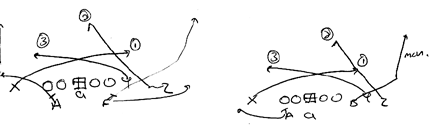
These two plays are basically identical, with the difference being that one has a fullback in the backfield who released into the flat and another has two tight ends, with the second tight end releasing into the flat. This is a concept that Shanahan/Bates have used to great effect with Steve Young, John Elway, Jake Plummer, and Jay Cutler (One of these things is not like the other...) and I would expect, given the repeated cries over the last three years for the Bears to take advantage of Cutler's ability to throw on the run, we will see it plenty this year:
Source: www.theburgundywarpath.com
This play is pretty self explanatory, really. Cutler fakes it to Forte and rolls right, while Marshall (X) runs a deep comeback to the play side (taking advantage of the gap between corner and safety, as the corner should stay to cover the second tight end (T) or the FB in the flats and the LB should be preoccupied with the first TE (Y) running the shallow cross) and the Z (Hester or Jeffery) runs either a deep post against Cover 2  in order to draw the safety deep or a deep dig against Cover 1 in order to get the safety to "sink" on the route. 

3)Inside Zone
This is a play that nearly every NFL team runs, and one that the Bears have already had a great deal of success with under Tice the last two years, but it's also a staple of the one-back offense that Tice/Linehan run and you'll see it plenty this year as well. 

Source: www.smartfootball.com
When you hear people talk about "zone runs" vs. man or power runs, the difference is what an "uncovered" lineman does. If a guard lines up and there's a defensive tackle right in front of him obviously his assignment is to block that guy. If there's not a defensive player directly in front of him, however, the offensive lineman's job is to shift towards the playside and double team the nearest defensive lineman. Once that defensive player is blocked, one of the two offensive lineman then shifts off to the nearest defender in the "zone" of the play. It's not really rocket science.

In the above version of inside zone, for example, the TE, RT, RG, and C all block the person covering them. The zone blockers are the LT and LG, who shift to block the WLB and the Nose Tackle, respectively. The runningback aims for the outside hip of the RG and shoot between the RG and the RT. If there's no opening there, he makes one cut and shoots back between the RG and the C. It's a running play that's both simple and effective, and Matt Forte and 30 other runningbacks will hear it called every Sunday. Tice has admitted in the past that it is his favorite running play, as he coaxed a 1300 yd season out of Michael Bennett and several great seasons from the two-headed monster of Fred Taylor and MJD largely off of this play during his time in Minnesota and Jacksonville, respectively. 

So there you have it. I'm guessing the Bears offense will be very similar to the one they ran the last couple of years after the annual "Run the Damn Ball, Martz" intervention, with the biggest difference being a considerable increase in the amount of play-action passes and bootlegs, and fewer screens in response to pressure. These three plays, however, will almost certainly be locks for the gameplan every week. I apologize for the length of this post, but, shit, I really don't. If you're here, I assume you came to read.


Friday, May 4, 2012

Ch-Ch-Ch-Changes: What the Switch From Mike to Mike Means for the Bears Offense

I was listening to Hub Arkush on the radio the other day and he was complaining, like many people, about the Bears failure to address the left tackle position in the draft. His critique of the people who keep saying that getting rid of Mike Martz will fix the Bears offensive line came down to this: the Bears didn't bring Jay Cutler in to throw a bunch of short passes, so simply dialing back the offensive isn't really a "fix."

I'm going to agree with Hub on the idea that the Bears didn't bring Jay Cutler into town to run an offense they could've run with Kyle Orton. I'm going to disagree, however, with the idea that Mike Martz wasn't the biggest problem.

It's true that the problem with seven step drops is overblown. That really wasn't the biggest problem with the Bears offense, and while they've said most of it has been thrown out, you'll still see them throw deep, probably out of the shotgun and especially off of play action. The issue was that Mike Martz's offense simply didn't suit the personnel he had.

I'll say here that I still think Mike Martz's offense could work in the NFL. It's not obsolete, but the the thing that Mike hasn't wanted to admitted since 2003 is that you absolutely need four things to make it work:

1) An accurate, dropback quarterback who can throw to a spot and hope that his wide receiver will be there.
2) An offensive line with TWO stalwart tackles, capable of blocking defensive ends on an island without any help.
3) Wide receivers who can run precise routes with absolute discipline and can also make the correct read on the many option routes that Martz utilizes (Martz basically borrowed the option routes from the Run N Shoot and melded them to the old Air Coryell system to create his offense).
4) A runningback that's as good of a receiver as he is a runner.

Let's look and see where things went wrong in Chicago on those four parts:

1) I'll admit that Jay Cutler, while he definitely improved under Martz and can be a great pocket passer when he has a pocket, isn't the most natural fit for Martz's offense. Jay came from look-based schemes in Denver and in college, and you really don't need a guy with Jay's skillset to run Martz's scheme. Jay's there to exploit openings and fire the ball into tight spots. Martz got career years out of marginal athletes like Trent Green and Marc Bulger simply because you don't need a cannon arm or the ability to scramble to take a seven step drop and throw the ball to a pre-determined spot.

2)The Bears certainly don't have two great tackles, and while I'm not as hard on J'Marcus Webb as many, we're all pinning our hopes on Gabe Carimi that they can manage to have at least one. This was the biggest issue, which is no surprise to anyone. In 2010 the line was absolutely terrible and couldn't manage the scheme at all. Last year, for that brief window in the preseason and the first game and a half when they had the healthy starting five of Webb-Williams-Garza-Louis-Carimi, they were running the real Mike Martz offense and doing pretty well with it, as Jay's numbers in the last two preseason games and the Falcons game show: 47/74 (63.5%), 653 yds, 8.8 YPA, 13.9 YPC. Unfortunately, Carimi and Lance Louis went down early and, for the next four games, just as in 2010, it took the rest of the world a while to convince Martz that he couldn't run the same offense with Frank Omiyale.

3) This, after the offensive line, was also the biggest problems. Now fools like me who desperately wanted to talk ourselves out of our initial gloomy reaction to the Martz hiring looked at some superficial things, like the small and speedy Johnny Knox (6'0", 185) and Devin Hester (5'10", 185) bearing some physical resemblance to Torry Holt (6'0'', 190) and Isaac Bruce (6'0", 188). Unfortunately, there's a difference between the Bears duo and the Rams duo, and it's quite simple: Holt and Bruce were good. Holt and Bruce could run the routes, get the separation, and make the adjustments that Hester and Knox just couldn't. Devin Hester's a lot of things. Smart is not one of them. As for Knox, well, lord knows how many interceptions he caused with shitty routes and his inability to take a god damn bump on a slant route.

4) Unfortunately for the Bears, Martz, since sometime around halftime of Superbowl XXXVI, forgot the fact that the single most important player for the Greatest Show on Turf was Marshall Faulk, and forgot Matt Forte for long stretches of time. Even in the games where the Bears offensive line took a lot of heat, the biggest problem was an unbalanced playcalling ratio that led to dozens of dropbacks and few runs to keep the defense honest. Take the Saints game this year for example: the stat sheet shows that Jay got sacked 6 times, which makes the offensive line look terrible, except the first sack came in the 3rd quarter, with the Bears still in the game, down 16-13. At that point, though, Martz had called 31 passes and just 10 runs. The final ratio? 52 pass plays, 11 called runs. Sure, there are teams like the Lions and Packers that throw the ball almost exclusively, but an average, but not necessarily terrible, line like this year's Bears line is going to look worse than their talent if they're asked to dropback 52 times, mostly on 5 man protections, with just 11 runs. That, my friends, is a far more heinous crime than calling seven step drops.

Now this sets me up for the crux of my argument: the new Bears offense isn't going to be "dialed back." They're not going to be running half a playbook or running the kind of stereotypical West Coast Offense (that may not even exist anymore, if it ever did) that people associate with noodle-armed guys like Jeff Garcia. They're changing philosophies. Martz believed in moving the ball in large chunks by dropping back and throwing timed routes to pre-determined spots downfield. The new Bears offense will be more or less what Cutler ran in Denver, the Mike Shanahan variant of the West Coast that began during Shanahan's time as OC in San Francisco when he worked with the athletic Steve Young and evolved during his time in Denver with John Elway. This is a look-based scheme that's going to feature a zone-blocking based run game, plenty of designed roll-outs and play action, and a wide range of 3 and 5 step drops that stretch the field horizontally and with the 15-25 yard intermediate routes that Brandon Marshall does so well. They'll go deep the way most NFL teams do, by exploiting blown coverages and defenses that cheat against the short stuff and move up against the run.

It's worth noting, mind you, that during the 11 games (including playoffs) after the Bears prevailed on Martz to "dial back" his offense after the Redskins game in 2010 and the 5 game winning streak after the Bears "dialed back" the offense after the first game at Detroit this year, the team went 13-3 and averaged 26 PPG (32 this year during the 5 game win streak) and Jay Cutler still managed 7.5 YPA and 13 YPC. If you think of most of the longest passes Jay's thrown during the last two seasons (the 67 yard bomb to Knox against Minnesota in '10, the three long TD passes to Knox and Hester against the Jets, the 48 yarder to Hester against Minnesota this year, the two long throws to Knox against the Chargers, the 58 yard pass to Olson in the playoff game) nearly all of them have come after the Bears had supposedly gone "conservative". The Bears didn't cut anything back. They simply ran the ball and took advantage of situations rather than attempting to force them. That's what they'll be doing with Tice and Bates, and it's a good thing.

More important than just the shift in approach, however, is this crazy idea Phil Emery has of matching his personnel to his scheme. You get an offensive coordinator who wants to utilize Jay's ability to throw on the run and make laser throws to tight spots. You get big, physical receivers in Brandon Marshall and Alshon Jeffrey who can win individual matchups. You have two backs (three, really, including Kahlil Bell) who can pound the ball inside and out and catch it very smoothly out of the backfield (combined receiving totals for Forte, Bush, and Bell in 2011: 108 receptions, 1041 yds, 3 TDs). Basically, you find whatever it is your guys do best and you send them out there to do just that. Football, as much as I often imply otherwise with my 25,000 word monologues, is sometimes that simple. Mike Martz may never be able to accept that, and it's why he won't be an NFL coach again.